
- I. Introduction
- II. The ODonnell Consent Decree: A Timeline of Reform
- III. Public Safety, Arrests, Demographics, and Misdemeanor Bail Reform
- IV. Multivariate Cost and Rearrest Analysis
- V. Implications for Bail Practices
- VI. Conclusion
- VII. Appendix
I. Introduction
In the United States, misdemeanor cases have been a prime testing ground for decisions whether to release a person who was arrested, pending their trial, because the cases typically pose a reduced public safety or flight risk but, due to their numbers, can burden jails, courts, law enforcement, and communities.[1] Today, most people in jail are awaiting trial and have not been convicted.[2] Bail matters disproportionately to those arrested for misdemeanors because, in such cases, any pretrial detention may constitute the bulk of the punishment imposed if a conviction results, which it often does not.[3] Misdemeanor bail policy has outsized impact given misdemeanors represent the highest volume of cases in the American criminal system.[4] Despite the low-level nature of these offenses, about one-quarter of people in jail are detained pretrial on misdemeanor arrests.[5]
The sizeable numbers of misdemeanor cases have made them a fruitful testing ground for decades of research and policy experimentation, which has shown that public-safety-focused alternatives to cash bail improve public safety and safeguard people’s liberty.[6] Yet, misdemeanor bail policy could not be more divided. Efforts to reform bail have continued to push in opposing directions, with calls for a turn away from cash bail-focused systems, calls to prevent release by increasing the use of cash bail, and calls to focus on detention, without bail, at least in more serious criminal cases.[7] Other jurisdictions have turned towards increased use of cash bail and/or pretrial detention, with fixed cash bail schedules quite commonly used.[8] At a time when lawmakers have reconsidered cash bail practices, they have often pointed to the work in Harris County, Texas, whether favorably or not.[9]
Academics have made new empirical arguments about the benefits of pretrial release, including arguments based on studies and findings in Harris County; and scholars have made new constitutional arguments about the legality of pretrial detention.[10] Meanwhile, judicial rulings have been mixed, with some courts quite skeptical of claims that pretrial detention schemes relying on cash bail raise constitutional concerns, or are judicially cognizable at all.[11] Bail reform lies at a crossroads, as contested as ever, at a time when we have more evidence than ever before about what works and what does not.[12]
Throughout this tumultuous period of reforms and counterreforms, the changes implemented under the ODonnell civil rights class action have steadily progressed, beginning with a preliminary injunction entered in May 2017,[13] and resulting in a Consent Decree in 2019.[14] In 2020, working with the parties to the litigation, other stakeholders, and community representatives, we commenced monitoring the implementation of new programs, training, and policies under the settlement. Today, Harris County has effected the largest scale and farthest reaching constitutional remedies in a misdemeanor bail system in the country.[15] As monitors, we have detailed the county’s accomplishments under that Consent Decree in a series of articles and reports,[16] including a detailed causal analysis examining cases before and after these key changes, showing no increase in repeat arrests.[17]
In this Article, we describe our updated work, many years in the making, documenting changes in caseloads, defendant characteristics, and case outcomes, as well as the public-safety benefits and cost savings that have resulted from the implementation of misdemeanor bail reforms.
II. The ODonnell Consent Decree: A Timeline of Reform
A. Before ODonnell
The Texas Constitution promises bail to almost all persons accused of crimes.[18] A bond is a promise, after arrest, to return to court in a criminal case.[19] A bond can be secured by a money payment, called bail in Texas,[20] or it can be unsecured, termed a “personal bond,” in which case the person promises to pay a stated amount if they fail to appear.[21] A secured bond may be guaranteed either by an up-front cash payment of the full bond amount,[22] or by a surety, who becomes liable for the full amount in the event the defendant fails to appear in court as required.[23] Additional bond conditions may apply to release, such as orders that a person not contact the victim, not possess a firearm, and comply with supervision conditions.[24]
Until bail statutes were amended in 2021, Texas law did not expressly prohibit the use of bail schedules by which local courts could make predetermined decisions about setting bonds.[25] Some jurisdictions, like Harris County, used fixed bail schedules to set bail without reference to individualized consideration, although this practice appears to have conflicted with the longstanding requirement that the decision be made based on a consideration of individualized factors.[26] In larger jurisdictions like Harris County, bail schedules were previously utilized to process and administratively release most arrestees without individualized consideration by a hearing officer.[27] In Harris County, approximately 50,000 misdemeanor arrests are made each year, resulting in detention, bail hearings, and then misdemeanor cases handled by the local Harris County Criminal Courts at Law (CCCL).[28] Misdemeanors in Texas are crimes punishable by up to one year in local or county jail. The most serious type in Texas is the Class A misdemeanor, punishable by up to one year in the county jail, and/or a fine of up to $4,000.[29]
We have previously described the misdemeanor process in Harris County in some detail.[30] For these purposes, we summarize that before the ODonnell lawsuit, not all persons were detained after arrest (some might be cited and released, for example), but for those that were, once the District Attorney’s Office accepted the charges based on a call with the arresting officer, a formal charging document would be prepared, requesting a secured bond amount according to the County Judge’s bail schedule, under then-existing Rules of Court 2.3.[31] The misdemeanor bail schedule required, for example, a $500 base amount of bail for misdemeanors, with additional $500 amounts added based on the charged offense and the person’s criminal history, reaching amounts as high as $5,000 for a misdemeanor.[32]
If a person could pay that amount, or retain a commercial bond agent, they could secure their release without ever being booked into the jail or appearing before a magistrate. However, if they could not pay, they would be booked into the jail and appear at a bail hearing. There, the magistrates would almost without exception honor those requests and were required to follow this schedule; thousands of people each year would be held in custody, at the sole discretion of the intake prosecutor, with the bail hearing typically serving as a very brief opportunity to give a magistrate the chance to order additional conditions of release such as a protective order.[33] Thus, the magistrates making those bail decisions apparently disregarded state law at the time, regarding the right to an individualized determination, and set the vast majority of cases according to the predetermined bail schedule that the CCCL judges had adopted.[34]
B. Preliminary Injunctions
In 2016, named plaintiffs Maranda ODonnell and others brought a civil rights class action in federal court, alleged that these practices were unconstitutional under the Due Process and the Equal Protection Clauses of the Fourteenth Amendment, and moved for a preliminary injunction to end the practices that led to these detentions.[35] On April 28, 2017, the District Court entered a preliminary injunction finding these practices unconstitutional.[36] After an appeal, that preliminary injunction was amended in several respects on June 29, 2018.[37]
The resulting preliminary injunction was different from the prior practices in several respects. Among its requirements, for misdemeanor defendants in custody and not subject to holds, mental competency determination, or family violence detention and who have an affidavit stating inability to pay an affordable bond within twenty-four hours of arrest, the sheriff must release the person on unsecured bond in the scheduled amount.[38] If seen as justified, as least restrictive, to protect public safety, a person can have a secured bond that is unaffordable imposed at a magistration hearing. A prompt bond review must be held the next business day for those who were detained on a secured bond.[39]
C. Rule 9 and the Consent Decree
In February 2019, following judicial deliberation regarding new local rules for misdemeanor pretrial decision-making, the parties jointly submitted Amended Local Rule 9 of the Harris County Criminal Courts at Law, which rescinded the prior secured money bail schedule and provided for a new set of procedures, requiring prompt release of misdemeanor arrestees except for six “carve-out” categories.[40] The court approved the amended rule, which took effect on February 16, 2019.[41] The new procedures were then incorporated into the ODonnell Consent Decree, entered in November 2019, which made broader changes to the misdemeanor bail-setting process in Harris County.[42]
To briefly summarize these procedures, with certain limited exceptions, persons arrested for misdemeanors must be promptly released through an administrative process, termed a “General Order Bond” (GOB).[43] Such misdemeanor arrestees must “have unsecured bail amounts set initially at no more than $100 and be promptly released on a personal bond with or without other non-financial conditions as soon as practicable after arrest.”[44] However, reflecting a balance between constitutional rights and public safety, Rule 9 denies administrative release to those in “carve-out” categories.[45]
Those not released administratively receive a more rigorous magistration hearing, complying with Rule 9. For people falling within the carve-out categories, a magistrate may grant a personal bond or a surety bond, as well as other conditions of release, such as protective orders or community supervision by Pretrial Services, including the use of interlock devices on vehicles in DWI cases. However, a magistrate must make a finding based on clear and convincing evidence to support the bail decision.[46] The misdemeanor bail hearings are held at the Harris County Joint Processing Center.[47] The Consent Decree requires magistrates to focus greater attention on the issues that matter—whether a person should be released and on what least-restrictive conditions.[48] Since 2017, the year after the ODonnell complaint was filed, all misdemeanor defendants have been represented by the Harris County Public Defender’s Office at their hearing.[49] Under the Consent Decree, in addition, counsel has access to the client and information needed to prepare for the hearing.[50]
D. COVID-19 Effects
The entire first year of the ODonnell Consent Decree was marked by the COVID-19 pandemic. The monitoring work began on March 3, 2020, shortly before March 11, 2020, when the pandemic was declared, and around the time that the first COVID-19 cases reached the Joint Processing Center in Harris County.[51] We have previously detailed the impacts of the pandemic on practices and outcomes; for example, we did not see any sharp change in arrests for misdemeanor cases.[52] What we did observe were longer case processing times, given the transition to virtual proceedings, and the difficulty of holding in-person criminal trials during the pandemic time period.[53]
E. After COVID-19
Finally, we will examine the most recent time period, after the pandemic was declared to have ended, to the present. As in-person trials resumed and the pandemic ended, we observed a steady reduction in the amount of time to process misdemeanor cases, as they proceeded to a judgment or dismissal.[54] The observed time period extends from December 31, 2022, to Spring 2022.[55] Before turning to each time period, we focus on an overview regarding the public safety impacts of these changes to the misdemeanor bail system in Harris County.
III. Public Safety, Arrests, Demographics, and Misdemeanor Bail Reform
Throughout the monitorship, the main data source relied upon to evaluate outcomes in Harris County has been the case-level records on all Class A and B misdemeanor cases filed in the CCCL.[56] These case-level records contain detailed information collected at different stages of the criminal justice process, from the time of a criminal case filing (e.g., case filing dates, types of criminal offenses and charges filed) to pretrial detention and bond decisions (e.g., types and amounts of bond filed, booking and release dates) to subsequent case disposition and repeat offenses (e.g., case disposition types and dates).[57] Unique, numeric identifiers, such as the case number and “System Person Number” (SPN) in the Harris County Justice Information Management System (JIMS), enabled these data elements from different stages of the criminal justice process to be accurately and reliably linked with each other.[58]
Our analysis primarily focuses on the misdemeanor cases, but we also use information from felony case records when considering the patterns of repeat offense among former misdemeanor arrestees.[59] Specifically, our key measure of repeat offense here is whether any new criminal case (misdemeanor or felony) is filed against a former misdemeanor arrestee within a certain time period (e.g., one year) from the original case filing date.[60] In the sections below, we describe our findings from updated data, spanning the time period between January 1, 2015, and June 30, 2025.[61]
A. Number of Misdemeanor Cases and Arrestees
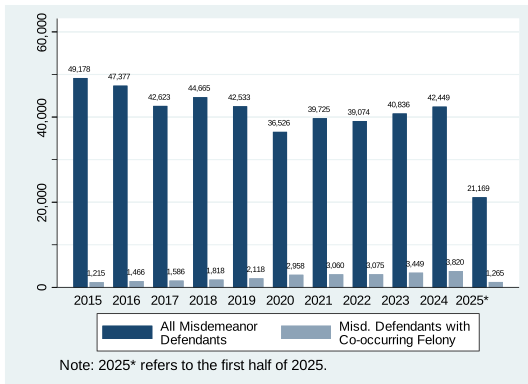
We begin our analysis by presenting the number of people arrested for misdemeanors in Harris County, by the year of case filing date. If a person is arrested multiple times during a calendar year, we count this person as a single observation. As shown in Figure 1, the number of misdemeanor arrestees has somewhat declined between 2015 (N=49,178) and 2024 (N=42,449). The number of misdemeanor arrestees during the first half of 2025 (N=21,169) is nearly identical to the number of misdemeanor arrestees during the first half of 2024 (N=21,696).[62]
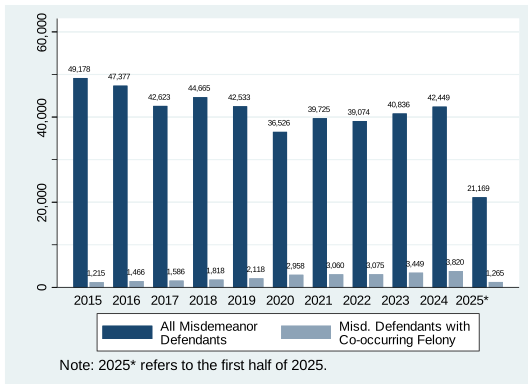
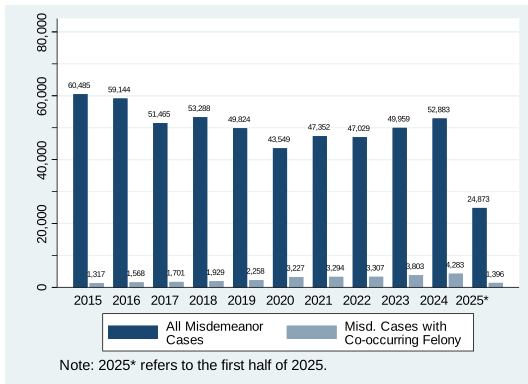
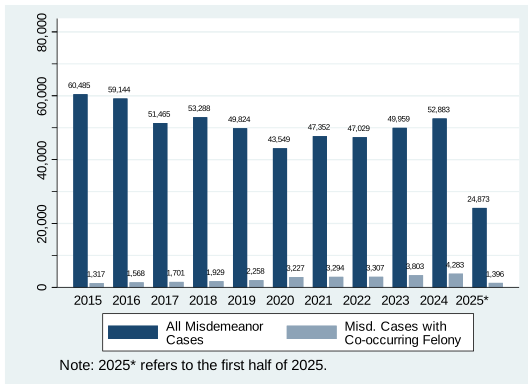
The number of people arrested for misdemeanors, presented in Figure 1, understates the number of misdemeanor cases, as some individuals may be arrested multiple times during a calendar year, and some are charged with multiple offenses from a single arrest. In Figure 2, we present the number of misdemeanor cases filed each year between 2015 and 2025, as well as the number of misdemeanor cases with co-occurring felonies.[64] The number of misdemeanor cases has also declined by 13% between 2015 (N=60,485) and 2024 (N=52,883). Both numbers are higher than the person-level counts presented in Figure 1, but overall, it is evident that both the number of persons arrested for misdemeanors and the number of misdemeanor cases in Harris County have declined in recent years.[65]
We also note that the increase in misdemeanor cases accompanied by a felony charge may not be interpreted as evidence that more misdemeanor arrestees are engaging in new or additional felony conduct. Rather, in these instances, the felony is typically the primary offense, and prosecutors have elected to file associated misdemeanor charges alongside it. The observed growth may therefore reflect charging practices, not necessarily a shift in underlying misdemeanor offending.[66]
In addition to a steady decline in the total number of misdemeanor cases (Figure 2), there have also been important changes in the offense type composition.[68] Relying on the offense categories used by the FBI’s National Incident-Based Reporting System (NIBRS), we present the breakdown of the misdemeanor cases by the type of offense.[69] Table 1 focuses on the five most commonly observed offense types, which together account for approximately two-thirds of all misdemeanor cases in Harris County in 2025.[70] Between 2015 and 2025, resources were increasingly directed toward more serious charges that threaten public safety, like assaults (12% to 22%), DWIs (16% to 22%), and weapon violations (3% to 6%). Conversely, less serious charges like theft (16% to 10%) and trespass (9% to 8%),[71] which often characterize repeat nuisance arrests for homeless or mentally ill people,[72] have been less commonly charged over time.
B. Demographic Characteristics of Misdemeanor Arrestees
We now examine the sex, race, and ethnic distributions of persons arrested for misdemeanors in Harris County and how they have changed over the last few years. Sex information is available for virtually all misdemeanor arrestees in Harris County. As documented in our previous reports, the sex composition of the misdemeanor arrestee population in Harris County has been very stable for years.[74] In each year between 2015 and 2024, males consistently made up about 75% of the misdemeanor arrestees.[75]
Race information, available for nearly all misdemeanor arrestees in Harris County, is categorized in one of the four groups, namely, African American, Asian, Native American, and White. However, African Americans and Whites make up the vast majority of misdemeanor arrestees; Asians and Native Americans only make up roughly 2% of the misdemeanor arrestee population (2.0% for Asians and 0.1% for Native Americans).[76] As in the sex distribution, the racial distribution of misdemeanor arrestees has remained very stable in recent years, despite the large reduction in the number of total arrestees.[77] In each calendar year between 2015 and 2024, African Americans and Whites accounted for approximately 40 and 60% of the misdemeanor arrestees in Harris County, respectively.[78]
Unlike sex and race, information on defendant ethnicity is missing for approximately 60% of misdemeanor arrestees between 2015 and 2025. “To overcome this data limitation, we implement an imputation technique which predicts individuals’ ethnicity based on their . . . last names.”[79] Our imputation method seems to yield reasonably accurate prediction results. Out of 149,787 misdemeanor defendants whose ethnicity information is available in the data, the predicted ethnicity correctly matched the actual ethnicity 92% of the time.[80]
Based on this imputed ethnicity measure, we find that the share of Latinx arrestees has gradually increased from 41% in 2015 to 46% in 2019 but has remained largely stable since then.[81] In 2025, 47% of misdemeanor cases in Harris County were filed against Latinx individuals.
C. Pretrial Detention
In Table 2, we examine the length of pretrial detention—defined as the days between booking and initial release dates—experienced by persons charged with misdemeanors.[82] Our focus is whether the length of incarceration has changed after recent misdemeanor bail reforms. We assign zero days of initial pretrial detention to cases that were never formally detained. Short pretrial detentions, lasting two days or less, became significantly more common after the 2017 implementation of misdemeanor bail reforms in Harris County, when the first preliminary injunction was adopted. Specifically, approximately 75% of misdemeanor cases involved short pretrial detentions in 2015 and 2016, but the share rose to 84% in 2017 and has remained stable since then, reaching 86% in the first half of 2025. By contrast, longer pretrial detentions lasting more than seven days were observed in approximately 14% of the misdemeanor cases filed before 2017, but their share has declined and remained stable at around 10% since then.[83]
D. Initial Bond Decisions
Under Rule 9, most misdemeanor arrestees who do not belong to one of the carve-out categories are now eligible to be released on a general order bond with an initial unsecured bond amount of $100 or less.[85] We examine whether this change is in line with the actual bond decisions observed in the data. To focus our analysis on the initial stage of the criminal justice process, our bond decision analysis only considers the first bond decision associated with a given case. For the same reason, we also omit from the analysis a small number of the cases in which the first bond decision took place after the first setting date.[86]
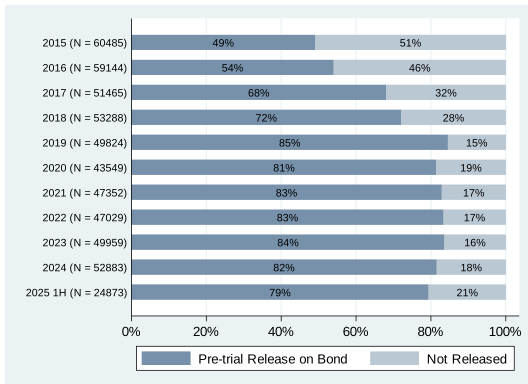
Figure 3 presents the share of misdemeanor cases in which defendants were released on a bond before the first setting by the year of case filing. We find that the release rate has substantially increased since 2017 (the year that the first preliminary injunction was in effect, in June 2017 to August 2018) and reached 84% in 2019 (the year when Local Rule 9 became effective). The release rate has slightly declined since then and was roughly 80% in the first half of 2025.[87]
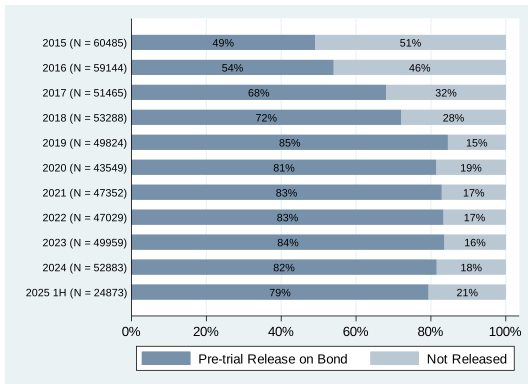
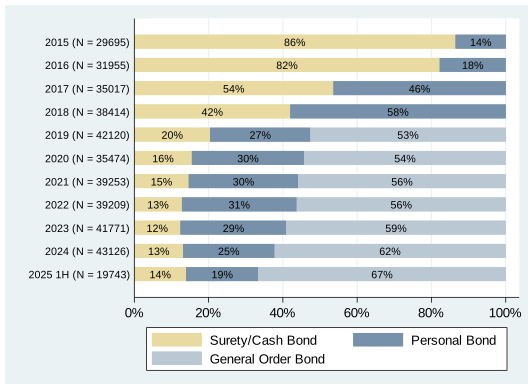
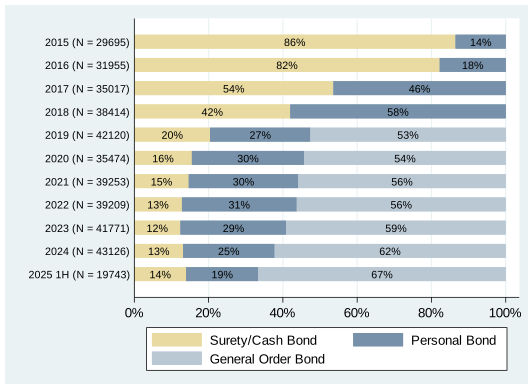
Arrestees released on a secured bond (cash or surety) face greater financial burden than those with an unsecured bond (personal or general order bonds).[89] In Figure 4, we observe a reduced use of secured cash and surety bonds over time, with the largest reductions taking place in 2017 and 2019, which coincides with the timing of the preliminary injunction (2017) and Local Rule 9 (2019). More than 85% of the cases filed in 2025 involved either personal bonds or general order bonds, which impose little financial cost on the arrestees.[90] Overall, the observed patterns in the initial bond decisions suggest that the level of financial burden associated with pretrial release has greatly diminished in recent years.
Next, we examine the distribution of initial bond amounts set and posted—a significant factor in whether the person can actually be released or not. Prior to Rule 9, many misdemeanor arrestees routinely remained in jail even though their bonds were approved because they could not afford the set bond amount.[92] Rule 9, however, required most misdemeanor defendants (barring a small number of exceptional cases) to be released with an unsecured bond amount of $100.[93] We thus examine whether these changes are in line with the distribution of bond amounts actually set.
We present in Table 3 the distribution of initial bond amounts set and posted by misdemeanor arrestees by the year of case filing. The top panel of Table 3 suggests that Rule 9 has reduced the bond amount set initially for most misdemeanor cases.[94] In virtually all misdemeanor cases prior to 2019, the initial bond amount was $500 or more—which is consistent with the bail schedule in place during those years. But since then, bond amounts of $100 or less have become more common and are now observed in more than two-thirds of the cases filed in 2024.[95] The bottom panel of Table 3 shows the distribution of initial bond amounts posted. We note that the number of observations in the bottom panel is often lower than in the top panel, suggesting that some of the surety and cash bond approvals that required people to pay to be released did not actually result in a release. Prior to 2019, the number of initial bonds that were approved but not posted (that is, the difference in the number of observations between the two panels) was very high, which is likely explained by the widespread use of surety and cash bonds during that period of time.[96]
A closely related question is whether the increased use of unsecured personal and general order bonds has led to an increase in non-appearance. In the absence of consistent and reliable data on actual court attendance, we computed bond “failure” as the share of approved bonds that were forfeited or revoked within a year.[98] Results in Table 4 show a relatively low overall bond failure rate for cases filed in 2015 (17%) and 2016 (16%). The rate then rose to 30% in 2018, and has gradually declined since then, reaching 26% in 2019 and 23% in 2021. However, the rate went up again in 2022 (26%) and 2023 (27%).[99] Note that these bond failure rates could not be computed for cases filed after the first half of 2024 because these cases cannot be followed up for a year yet.
Lastly, we explore the pattern of pretrial release for each sex, race, and ethnic group, and examine whether the disparity in pretrial release rates has changed since the implementation of the bail reforms. Panel (A) of Table 5 presents the pretrial release rate, defined as the share of misdemeanor cases in which a person was released on a bond before the first setting, for each sex, race, and ethnic group. Substantial disparities in pretrial release rates between females and males, Blacks and Whites, and Latinxs and non-Latinxs rapidly narrowed between 2015 and 2019 and have stabilized since then. Overall, the sex, race, and ethnic disparities in pretrial release rates during the first half of 2025 (3, 3, and 3 percentage points, respectively) remain considerably smaller than in 2015 (10, 16, and 15 percentage points, respectively).[101]
Panel (B) of Table 5 shows the rate of pretrial release on an unsecured bond for each sex, race, and ethnic group. With the growing use of personal and general order bonds, unsecured pretrial release has increased dramatically for all demographic groups considered, especially when one compares the years before and after bail reforms.[102] For example, unsecured releases were the minority before the adoption of Rule 9 in 2019, whereas they have remained at nearly 70% for all demographic groups since then.[103] Moreover, the differences between sex, race, and ethnic groups have been modest and have remained mostly stable. As of 2025, the sex, racial, and ethnic disparities in pretrial release on an unsecured bond only amount to 3.3 (female vs. male), 1.0 (Black vs. White), and 0.3 percentage points (Latinx vs. Non-Latinx), respectively.[104]
E. Case Disposition Outcomes
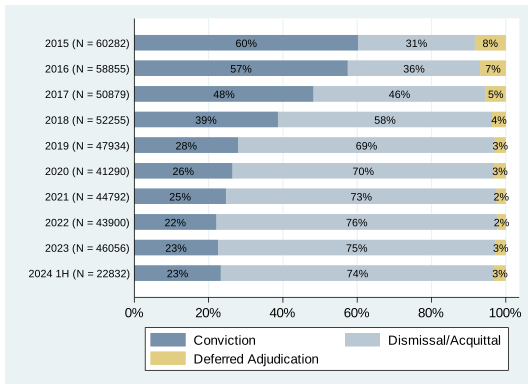
As documented above, the recent misdemeanor bail reforms significantly changed the patterns of pretrial detention and bond decisions, which in turn created more favorable conditions for disposition outcomes of misdemeanor cases filed during this time period.[106] We begin our analysis by presenting the distribution of case disposition outcomes for the cases filed between 2015 and 2024 in Figure 5. Misdemeanor cases filed after mid-2024 are again excluded because many remain undisposed. We also drop any misdemeanor cases without a recorded disposition, instead focusing on cases with observed outcomes. (The share of not-yet-disposed misdemeanor cases is 8% in 2023 and 11% in the first half of 2024.)[107]
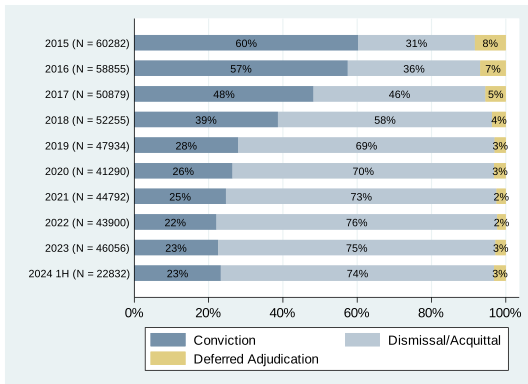
We find bail reforms coincided with a reduced rate of criminal conviction. The share of misdemeanor cases that resulted in a criminal conviction has substantially declined between 2015 (60%) and 2024 (23%), while the share of cases dismissed or acquitted has risen from 31% to 74%.[108] This finding indicates that the number of guilty pleas has also declined, as more than 99% of misdemeanor convictions come from a guilty plea.[109]
To better understand this figure, two things should be kept in mind. First, before ODonnell’s bail reform, many people who were detained pretrial pled guilty in exchange for a promise of immediate release, often with a sentence of “time served.”[110] Even innocent people will agree to plead guilty under such circumstances.[111] Second, since bail reforms were adopted, the District Attorney’s Office has implemented a number of diversion programs to enable people to obtain a dismissal of charges by completing a therapeutic program or community service.[112]
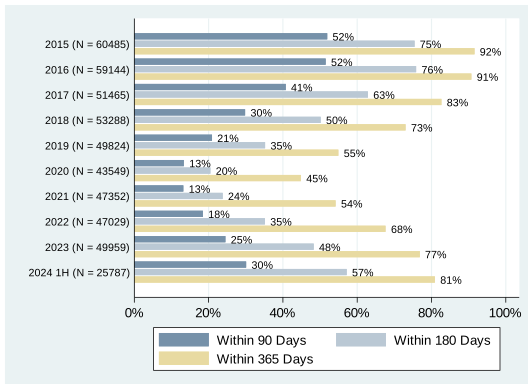
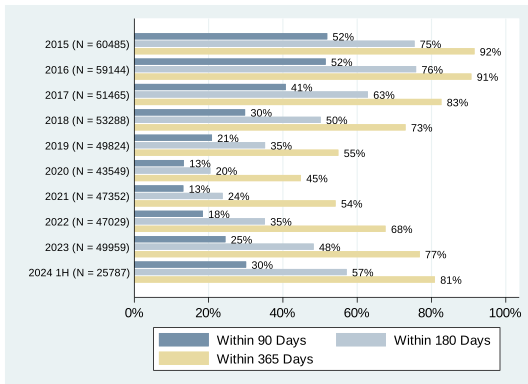
Another question is how misdemeanor case resolution times have changed since Rule 9 took effect. To assess this, we compute the number of days from filing to initial disposition and, in Figure 6, show the share of cases resolved within 90, 180, and 365 days. Results show cases filed in recent years tend to remain open for a longer period of time. For example, most cases (52%) in 2015 were disposed within three months of the case filing, but this share fell to 25% in 2023.[114] Likewise, about 90% of the cases filed in 2015 and 2016 were disposed within a year, but the number fell to 45% in 2020.[115] However, we also observe that the share of cases disposed within one year has increased since then (54% for 2021, 77% for 2023, and 81% for the first half of 2024).[116]
F. Repeat Arrest
In this section, we explore the pattern of repeat offenses by persons charged with misdemeanors using several different measures, namely, (1) the share of persons charged with misdemeanors and then with a new offense within a year of the initial case filing date (person-level repeat-offense), (2) the share of misdemeanor cases in which the same person was charged with at least one new crime (case-level repeat-offense) within a year of the initial case filing date, and (3) the share of misdemeanor cases filed each year that were charged against former misdemeanor arrestees from the previous year.
Consider the first two measures first. To obtain the case-level repeat-arrest rate, we follow all misdemeanor cases filed during a calendar year and compute the share of cases followed by a new criminal case filing within 90, 180, and 365 days. To compute the person-level repeat-arrest rate, we follow all misdemeanor cases filed against the same individual during a calendar year and consider whether any of these cases were followed by a new criminal case filing within 90, 180, and 365 days.
We begin our repeat offense analysis by presenting the person-level rate of repeat arrest within 90, 180, and 365 days. The share of misdemeanor arrestees who had a new criminal case filed within a year has changed minimally between 2015 (23%) and 2024 (24%).[118] In fact, the rates of new cases filed within 90, 180, and 365 days have remained remarkably stable between 2015 and 2024.[119] As before, persons arrested for a misdemeanor offense in the second half of 2024 are dropped from this analysis as they cannot yet be followed up for a year.
Table 7 presents the share of new cases filed within 90, 180, and 365 days of the initial case filing date, this time measured at the case level. As expected, this case-level measure yields a slightly higher rate of repeat-arrest than the person-level measure, but the difference is rather modest. For example, 28% of misdemeanor cases filed in the first half of 2024 were followed by a new criminal case filing within a year, whereas 24% of misdemeanor arrestees had a new criminal case filed within a year.[121] Similar to the person-level analysis, the rates of repeat arrest within 90, 180, and 365 days have remained stable between 2015 and 2024.[122]
In addition, we present the share of misdemeanor cases followed by another case before the initial case was disposed (“pretrial repeat arrest rate”), which has increased from 9% in 2015 to 28% in 2020 and then declined to 19% in 2024.[123] We find that the 90-day, 180-day, and one-year repeat arrest rates have all remained stable during this time period.[124] Therefore, it is highly likely that the changes in the pretrial repeat arrest rates over time are mainly driven by the changes in time-to-disposition, given that, in this measure, we examine whether a case was followed by another before the initial case was disposed.
G. Conclusion
To summarize, in the years since the ODonnell Consent Decree was adopted, a number of quite positive impacts can be observed. First, the numbers of persons arrested for misdemeanors have declined since 2015.[126] In addition, the numbers of persons rearrested have also declined, with rearrest rates that have remained stable.[127] The numbers of persons released on bond have increased.[128] There had been substantial disparities in pretrial release rates between females and males, Blacks and Whites, and Latinxs and non-Latinxs, and these gaps rapidly narrowed after the misdemeanor reforms were introduced, and stabilized since then. The demographics of those arrested for misdemeanors have remained stable as well.[129] And there has been a steady increase, post-pandemic, in the numbers of cases disposed more quickly.[130]
IV. Multivariate Cost and Rearrest Analysis
In this Part, we turn to new analysis building on earlier work, in progress for several years, examining the costs of misdemeanor bail reform and effects on rearrest.[131] In the sections that follow, we briefly describe the analytic methods used, then report multivariate findings comparing cost outcomes for cases of equivalent risk and type. Descriptive statistics, reported alongside the multivariate results, help contextualize the policy-related cost drivers in each time period described in Part I.
A. Multivariate Cost and Rearrest Analysis Methods
Ordinary least squares (OLS) regression was used to estimate the effect of four major ODonnell-related policy regimes on costs of misdemeanor case processing while accounting for other factors that could plausibly explain observed changes.[132] Multivariate methods were also used to assess policy impacts on future offending. Cases with Class A or B misdemeanor charges[133] entering custody between January 1, 2015 and January 15, 2023 were tracked for 36 months after the initial bond or booking date.[134] Within that three-year follow-up period, 98% of cases in the 370,989-case sample reached final disposition, allowing complete information on their processes and outcomes.[135] The Appendix details the elements of the model: (1) policy milestones hypothesized to drive cost effects (i.e., independent variables), (2) cost outcomes (i.e., dependent variables), and (3) control variables that hold constant other influential factors.[136]
B. Comparisons Across Each Policy Period
Findings summarized below (Table 8) show policy changes implemented under the ODonnell lawsuit reduced overall misdemeanor system costs by 33% with $1,191 in net savings per statistically comparable case. Importantly, these savings were attained even while increasing due process and justice-related investment by $544 per case—57% more spending than in the pre-reform baseline. A majority of these savings (60%, or $714 per case) accrued to Harris County systems, while the remaining 40% ($477 per case) directly benefited defendants.[137] Crucially, policies that have lowered financial burden for the accused have also been the main engine of county cost savings.[138] The data to follow shows, as pretrial release became more attainable, demand for costly county processes like bookings, screenings, bond hearings, and pretrial detention declined accordingly.[139] Moreover, as people were increasingly able to prepare their cases while free from detention (shown in Table 13), more court settings and adversarial representation (shown in Table 17) facilitated dismissal of likely weak cases (shown in Table 15), avoiding downstream sentencing costs (shown in Table 16) for detention-coerced pleas.[140] In these ways, reforms enhancing fairness and constitutional protections for defendants generated substantial financial dividends for Harris County.
Equally important, these constitutional and financial gains were achieved without compromising public safety (Table 9). Controlling for case and defendant characteristics, the share of arrests followed by any new charges within three years fell 5%, the average number of rearrests per initial arrest declined by 12%, and costs of repeated criminal involvement were lower by $310 per case after bond reforms.[141] The sections that follow illustrate the underlying operational mechanisms driving these transformative changes.
1. Bond Reform Reduced Processing Costs by $1,735 for Statistically Similar Cases
Before the ODonnell lawsuit, wealth-based detention was the prevailing practice: Regardless of personal risk level or financial means, 89% of Harris County misdemeanor cases faced a secured bond averaging $3,475.[146] After the earliest reform—the preliminary injunction—halted release based on ability to pay, cases with secured bonds were cut nearly in half to 46%, and the average secured bond amount fell to $1,806.[147] When the Consent Decree made unsecured release the presumptive norm, secured bond cases fell by half again, leaving just 23% of cases subject to financial conditions of release at an amount one-third that of pre-reform levels ($1,099).[148] Among cases with similar characteristics, the ODonnell litigation reduced bond costs by a remarkable 99%, from $320/case at baseline to just $4 under Rule 9.[149] Moreover, expanding unsecured release relieved cost pressures throughout multiple components of Harris County’s criminal justice system.[150]
A large majority of defendants entering custody undergo formal booking where they are charged, fingerprinted, screened for medical and mental health needs, and processed for bond.[152] Yet, while booking rates since 2015 have been stable or rising,[153] costs for comparable cases have declined by 28%.[154] The reason is the growing use of unsecured bonds. Personal bond bookings—which clear the Joint Processing Center in two-thirds the time of secured bonds—increased fivefold under the Preliminary Injunction.[155] Under the Rule 9 policy regime, an even larger share of cases (53%) booked as GOBs completed booking in one-third the time of secured bond bookings.[156] Altogether, faster processing times associated with unsecured release brought booking costs for statistically similar cases from $299 to $214, a 28% decline from the pre-reform baseline.[157]
Until Rule 9 took effect, Pretrial Services prepared a detailed screening report for the roughly 80% of people booked on misdemeanor charges. These reports assess the risk of pretrial misconduct and inform release recommendations by hearing officers and, later, the courts.[159] The cost to generate each screening report for statistically equivalent misdemeanor cases was $54 in the pre-reform era.[160] With Rule 9, however, time- and cost-intensive record assembly was eliminated for the 53% of low-risk misdemeanor cases newly eligible for automatic release under GOB bonds.[161] By individualizing pretrial treatment to align with differing risk profiles, screening costs declined by more than one-third, to $34 for comparable cases.[162]
Before bond reform, nearly seven in ten cases had a hearing to impose a secured (61%) or personal bond (8%).[164] Subsequent reforms created new pathways for unsecured release without the need for a hearing.[165] The early presentment process, pioneered during the preliminary injunction, allowed Pretrial Services staff to identify and recommend defendants suitable for personal bond in advance of a hearing.[166] Under Rule 9, GOBs went further, presuming all defendants to be eligible for unsecured release unless they met “carve-out” risk criteria.[167] Once risk became the determining factor, bond hearings declined from 69% of cases before reform to 40% under the Preliminary Injunction, reaching 32% under Rule 9.[168] Presumptive unsecured release lowered hearing costs by 45%—from $75 to $41 per statistically similar case—while confirming that low-risk defendants can be safely and efficiently released without a formal judicial review.[169]
Prior to reforms, when pretrial release was determined by ability to pay a scheduled secured bond, nearly a quarter of cases (23%) were still in custody three days after arrest;[171] 90% were released over a period of nine days.[172] Though initial detentions averaged around five days per case,[173] this masked a critical fact. More than one-in-three defendants were released after pleading guilty, with up to nine times more detention-coerced pleas than in later periods.[174] The Preliminary Injunction fundamentally changed this dynamic by shifting pretrial release criteria from financial ability to assessed risk.[175] Three-day detentions fell by two-thirds (to 8%), 90% of cases were released by day two, and average detention length fell by 1.6 days—all of which cut pretrial detention costs for statistically comparable cases by one-third (from $425 to $281/case).[176]
When key Preliminary Injunction policies were denied in the Amended Injunction,[177] earlier declines in secured bonds were partially undone.[178] Metrics—including three-day detentions, average jail days, and the 90th percentile—all reversed progress.[179] GOBs under Rule 9 restored some of the prior gains; otherwise, average jail days remained largely stable until COVID disruptions.[180] Ultimately, pretrial detention costs under Rule 9 stabilized 34% below the pre-reform mean with $144 in net savings for statistically similar cases.[181]
Reducing the cost of pretrial release also enabled more defendants to meaningfully defend their charges while free in the community. Greater pretrial liberty and stronger defense advocacy, in turn, moderated both dispositions and sentences. Table 15 shows that overall plea rates fell from 58% of dispositions before reforms to 26% under Rule 9. Pleas taken within seven days of custody dropped from 23% to just 2%, and potentially coercive pleas entered during initial detention declined from 36% to 4% of cases. As guilty pleas decreased, dismissals rose from 33% of dispositions before the preliminary injunction to 67% after Rule 9.[183] Moreover, because court costs in Texas were not assessed in cases dismissed before a plea or diversion, these changes also eased defendants’ financial burden, reducing average fees and fines by 76% from $261 to $63 among comparable cases.[184]
The share of cases resulting in a jail sentence also fell by 31 percentage points under Rule 9, and average jail terms shortened by nine days compared to the pre-reform era.[186] Likewise, the proportion of cases receiving a probation sentence declined by one-third (from 6% to 4%), with terms 11.3 days shorter on average. Costs for both jail ($837 reduction per case) and probation ($101 reduction per case) were reduced by roughly 75%, other things equal.[187] By freeing appropriate defendants from pretrial detention, bond reform has supported fairer and more effective advocacy, yielding better outcomes for defendants and lower costs for county systems.
2. Bond Reform Increased Due Process Costs by $544 for Statistically Similar Cases.
Harris County bond reforms have improved longstanding underinvestment in pretrial justice processes, while contextual factors have amplified rising court-related expenditures. As more defendants gained access to affordable bonds and were able to contest charges outside the duress of incarceration, due process costs like court settings and attorney involvement naturally rose. With more active legal engagement, cases remained open longer and involved more court appearances, driving costs upward. Table 17 shows the number of settings rose 92%, from five per case before reforms to 9.6 after Rule 9, and average case duration more than tripled from 126 to 391 days.[189] As a consequence, costs of court appearances increased by 55% ($94/case) relative to statistically similar cases in the pre-reform period.[190]
Notably, however, enhanced defendant advocacy has not been the only driver of rising court costs. By keeping more defendants free in the community while their case was being resolved, reforms increased opportunity for missed appearances: initial bond failures more than doubled from 10% of cases at baseline to 23% after Rule 9, peaking at 27% under the Preliminary Injunction.[192] Bond failures lead to more court appearances, adding 3.2 more settings/case on average across all policy intervals.[193] At the same time, during the Preliminary and Amended Injunction eras, missed appearances became harder to avoid as rule changes[194] and the disruptions caused by Hurricane Harvey made it more difficult for defendants to be present in court.[195]
Rising court costs, therefore, stem from multiple sources as pretrial release is linked to more settings, longer case durations, and higher bond failure rates.[196] Yet, in a legal system that rightly prioritizes pretrial liberty and meaningful adversarial process, broad access to the courtroom—and the higher setting costs that accompany it—may be an inherent and acceptable price to ensure fair and equitable justice.[197]
Matching court costs, attorney expenses also rose. Table 8 shows prosecution costs for statistically comparable cases grew from $441 in the baseline interval to $724 after Rule 9—a 64% increase. Defense costs for a typical case averaged $104 for court-appointed representation and $243 for private counsel before reforms.[198] After Rule 9, they increased 125% (to $234) and 15% (to $280), respectively.[199] With the attorney appointment rate remaining stable around 57% of misdemeanor cases in every policy period,[200] the added cost primarily stemmed from more courtroom processes. Lawyers participated in twice as many court settings after Rule 9 than before reforms.[201]
The cost of court-appointed counsel was also affected by needed defense system improvements. In 2017, the Public Defender’s Office began providing representation at bond hearings; and in 2020, the Managed Assigned Counsel program was launched to supervise and support private appointed attorneys.[203] These innovations raised both the quality and cost of representation for indigent defendants, marking a move away from perfunctory case handling toward more substantive, well-supported advocacy.[204] As with court settings, increased investment in the amount and quality of adversarial representation is necessary and appropriate in a fair and just legal system—one that ensures case outcomes are based on facts and due process rather than on a defendant’s financial means or pressure to plead.
3. Bond Reform Reduced Rearrest Costs by $310 for Statistically Similar Cases.
Among the most persistent and contentious concerns about bond reform is whether releasing individuals without a financially secured bond increases the risk of new offenses and jeopardizes public safety.[205] If secured bonds enhance community safety, rearrests within three years of an initial detention would be lowest during the pre-reform era, when 89% of Harris County defendants faced financial conditions for release. In fact, the opposite pattern emerges.[206]
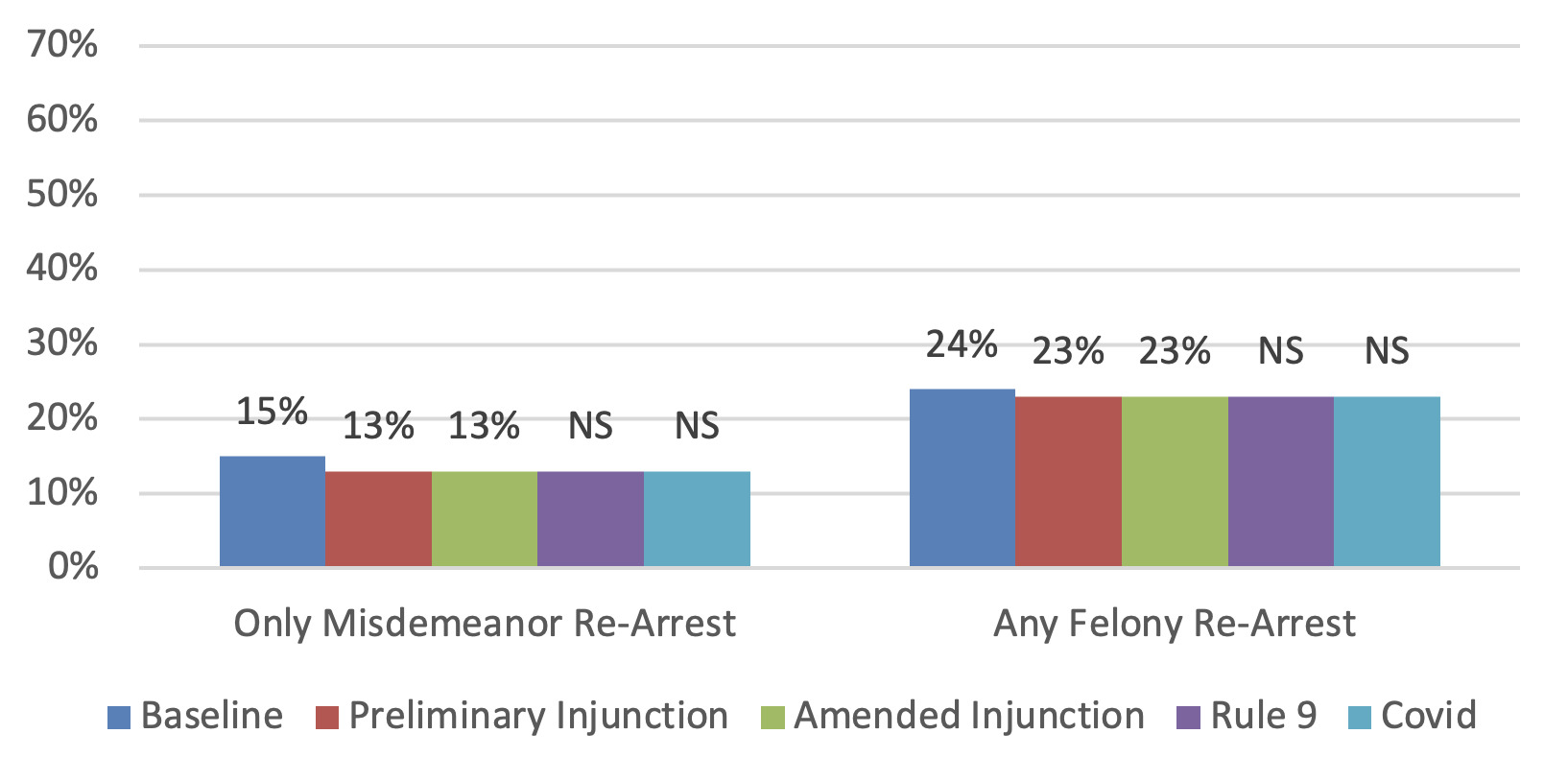
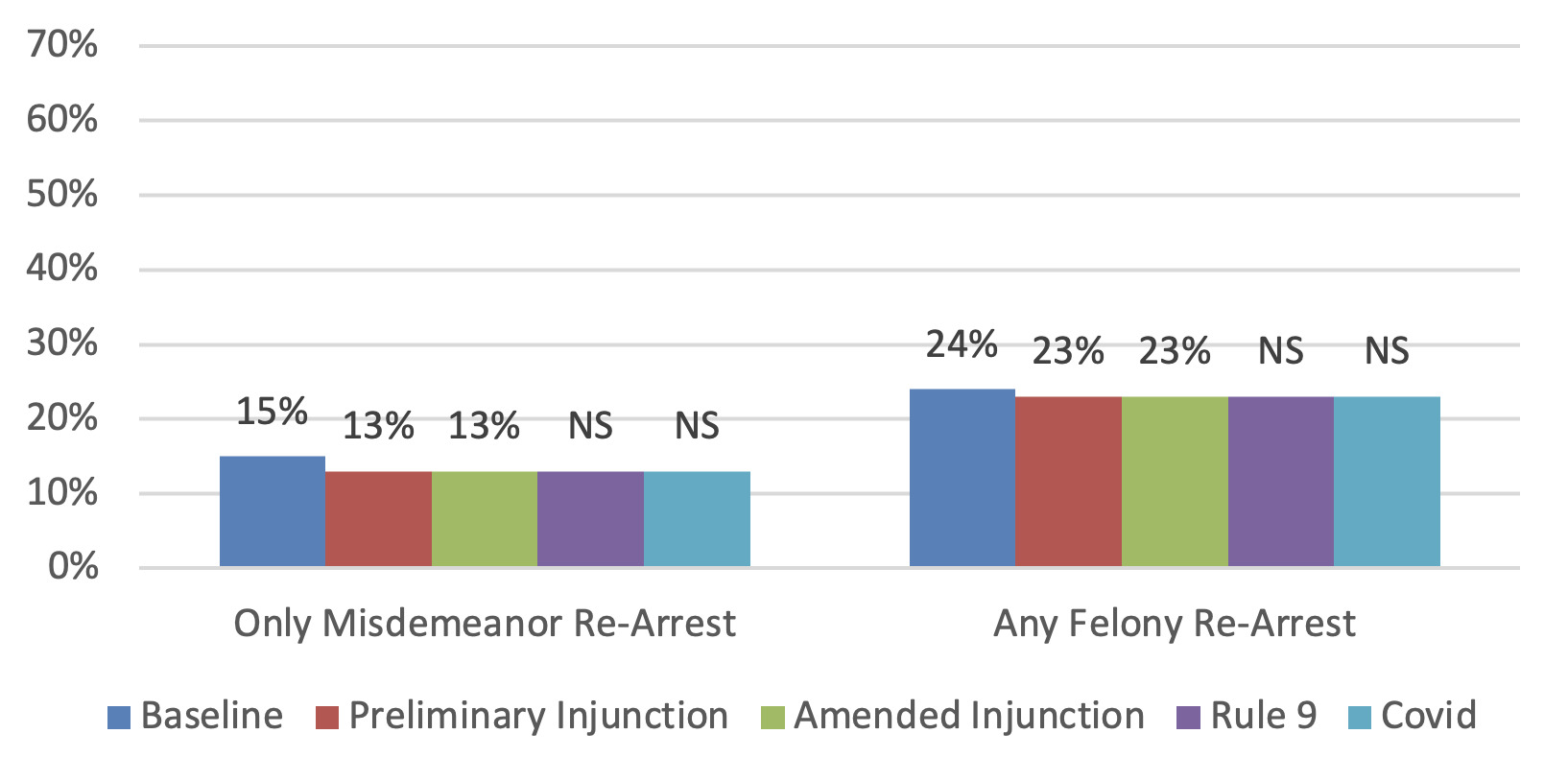
Figure 7 shows the share of statistically comparable misdemeanor arrests with any subsequent contact with the Harris County justice system. The share of arrests experiencing at least one rearrest was highest in the pre-reform baseline: 15% involved a rearrest with no felony charges, and 24% led to at least one new felony arrest. After reforms, these metrics were 1 to 2 percentage points lower—a small but statistically significant difference. Thus, over a period when secured bonds fell from 89% to 21% of cases under Rule 9 (Table 10), the share of comparable cases with future criminal justice involvement declined and remained stable.[207]
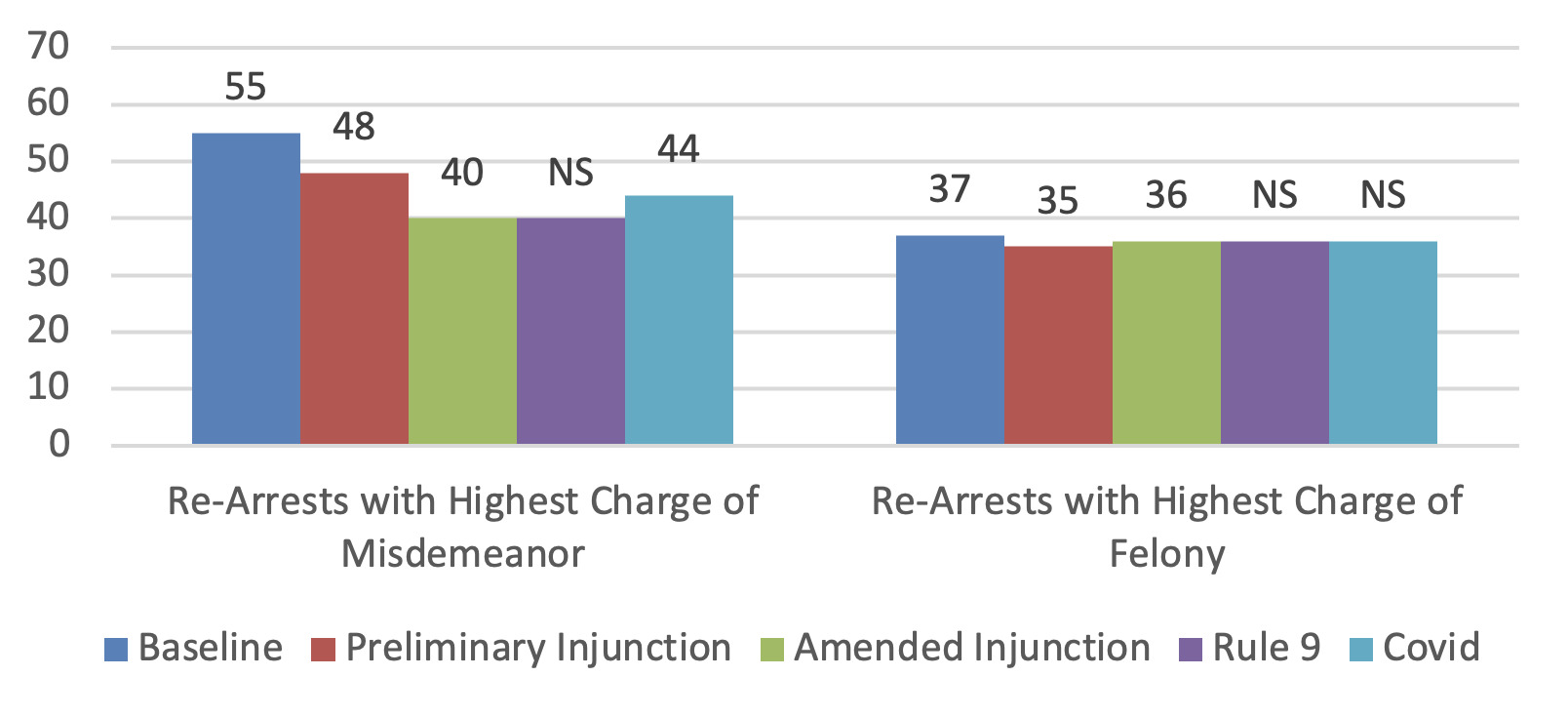
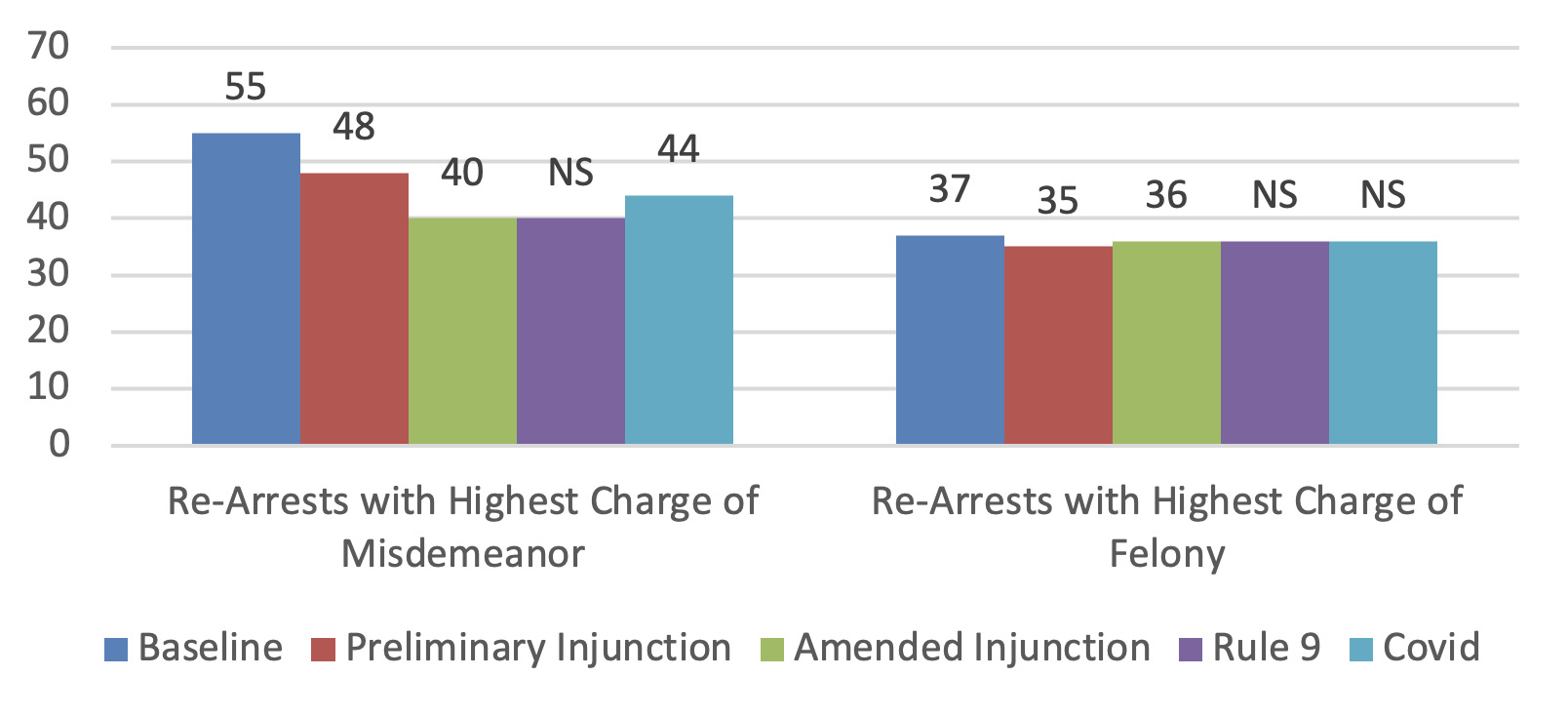
While the proportion of arrests with any future charges remained lower after reforms, it is also important to consider whether rearrest volume increased. Figure 8 shows, among cases of equivalent risk and type, the number of new arrests with the highest charge of misdemeanor fell by a striking 25%, from 55 rearrests per 100 arrests in the pre-reform era to a low of 40 after reforms. Although misdemeanor rearrests rose slightly (by four per 100 arrests) for cases arrested during COVID, the overall reduction associated with bond reform remains substantial. Felony rearrests declined more modestly—from 37 to 36 per 100 arrests—and remained stable under Rule 9.[210]
By reducing the frequency and volume of rearrests, bond reform also lowered their financial impact. Before reform, costs to Harris County and defendants for future criminal justice contact averaged $7,760 per statistically comparable case.[212] Consistent with a sharp decline in new charges during the Preliminary Injunction period, costs fell most in this initial reform phase, reaching $7,450 and remaining stable thereafter. Overall, the ODonnell litigation brought rearrest costs down by 4%, yielding average savings of $310 per case.
Taken together, the results show a consistent and important pattern: Even as secured bonds became the exception rather than the norm, statistically similar defendants were less likely to face future criminal charges after bond reform than before it. This conclusion is intuitive: A person’s ability to afford a secured bond is not a reliable indicator of dangerousness.[213] In fact, wealth-based detention has been shown to disrupt employment, housing, and family connections that ordinarily protect against reoffending. Allowing low-risk defendants to await trial in the community preserves these stabilizing factors and reduces the likelihood of future criminal involvement.[214] Moreover, a risk-based bond system properly reserves costly pretrial detention for individuals who present true threats to public safety.[215] These findings therefore demonstrate that replacing wealth-based detention with individualized, risk-informed release increases case processing efficiency, strengthens constitutional fairness, and not only maintains, but enhances community safety.
V. Implications for Bail Practices
A. The Public Safety Benefits of Early Release
In this Article, we have described updated findings consistent with several years of previous analysis, showing strong evidence that reducing reliance on misdemeanor pretrial detention has public safety benefits.[216] The descriptive data demonstrates this quite simply, with results that are not hard to convey and require little analysis (although in separate work we have conducted detailed empirical examination of these data, and we present additional regression analysis here).[217] Over time, misdemeanor arrests and rearrests have declined in number, and rates have remained stable.[218] The cost analysis described in the last Part details, using regression analyses, how the costs of the bonding process declined, outweighing increases in certain court-related costs, and how statistically similar defendants were no more likely—and often less likely—to face new charges after bond reform than before it.
B. The Costs and Benefits of Process
Very little research has examined the costs involved in the pretrial process in the United States,[219] much less how those costs shift when pretrial processes are revamped. We have described how, in examining the costs and benefits of the reforms introduced under the ODonnell Consent Decree, some costs are increased, including court and attorney expenses essential to due process; but we see large offsetting savings in the cost of bond, bookings, pretrial screenings, bond hearings, sentences, and fees and fines.[220] Each of these are important and costly items for the County and for defendants. These findings all suggest how the procedural due process safeguards in the Consent Decree are comparatively inexpensive.
The analyses presented have constitutional implications, because the constitutional test itself reflects a type of cost-benefit balancing, as does much of modern procedural due process doctrine.[221] The Due Process Clause, found to have been violated by the prior practices in Harris County, anticipates a balancing between government interests and pretrial liberty interests.[222] In Salerno v. United States, the United States Supreme Court did not specify how to conduct that balance, but forbids deprivation of liberty that is excessive with respect to legitimate and compelling government interests in public safety as well as in securing court appearance.[223] We have not only detailed the benefits to public safety under this Consent Decree. We also show that across a range of case processing domains, that these reforms have been financially beneficial to the County.
We conclude, as under our previous analysis, that there is strong evidence that misdemeanor pretrial detention under cash-bail systems not only violates people’s rights, under arbitrary procedures and unequal impacts, but ending such practices has public safety as well as cost benefits.[224] While the Due Process Clause does not call for a detailed cost-benefit assessment, but rather a balancing of interests,[225] we have conducted a more comprehensive analysis. If a more reliable Salerno balancing were conducted regarding misdemeanor bail in Harris County, the conclusion should be that the constitutional remedies under the Consent Decree far better satisfy that balance.
VI. Conclusion
As the Supreme Court put it in United States v. Salerno, “[i]n our society liberty is the norm, and detention prior to trial or without trial is the carefully limited exception.”[226] Pursuing effective policymaking while satisfying constitutional mandates requires that bail rules should properly balance a person’s pretrial liberty interests against society’s justice and safety interests. The experience in Harris County suggests that it is not a zero-sum trade-off. It is not the case that pretrial due process protections will reduce public safety, nor will they impose high financial costs on taxpayers. Instead, due process protections come with cost savings in terms of incarceration expenses avoided, in addition to public safety benefits. For the affected individuals, implementing these protections also furthers their constitutional rights and liberty interests. Win-win policy solutions do not often present themselves so starkly, particularly in the field of criminal justice.[227] We hope that the lasting lesson of ten years of misdemeanor bail reform data in Harris County demonstrates that improving the fairness of the process and securing liberty for far more people are not only inexpensive but also save money and improve public safety.
VII. Appendix
A. Policy Intervals
While Rule 9 was the central reform under the Consent Decree, other court-ordered policy changes occurred before the settlement.[228] Table A-1, below, presents the full set of intervals examined with a summary of pivotal policy developments. Their cost effects were evaluated using dummy variables marking the policy regime in effect at the time a case entered custody.[229] Overlaying these formal policy transitions, Harris County case processes were also shaped by two major non-policy disruptions: Hurricane Harvey and COVID-19. The effects of Hurricane Harvey, fully contained within the Preliminary Injunction interval, were controlled using a dummy variable to isolate storm-related disruptions from the underlying policy effects of the Preliminary Injunction.[230] In contrast, because the COVID-19 period was ongoing when the last cases entered the study sample,[231] a similar dummy control could not be applied. Accordingly, multivariate results for the Rule 9 interval are presented without COVID controls.
B. Cost and Rearrest Outcome Measures
Both cost and rearrest outcomes were hypothesized to be affected by ODonnell-related policy changes. Most cost measures, summarized in Table A-2, were derived from FY 2020 operational budgets and case counts for Harris County criminal justice departments. Secured bond, private defense, and probation sentence costs were extrapolated from external reference materials, and case-level court fees/fines were provided by the District Clerk’s Office.[232] Because prosecutor cost data was unavailable, public defender rates were substituted. Where a single cost applied to multiple cases entering custody on the same date, the expense was prorated across all co-booked cases to avoid overstating per-case costs.
In addition to measuring cost impacts, two rearrest outcomes were also constructed to evaluate whether pretrial release policies were associated with changes in future offending. These included (1) a binary indicator of any rearrest within three years of custody, and (2) a count of new arrests during the same three-year period. Rearrests for statistically similar cases were compared across policy intervals using the same multivariate methods as for cost outcomes. Results for the Rule 9 interval were separated before and after the COVID-19 start date to more clearly illustrate pandemic-related effects.
C. Control Variables
The final components of the regression models are the control variables, which are included to reduce confounding from factors unrelated to the policies under study. These controls help isolate the effects of the policy intervals on both costs and rearrest outcomes net of differences in case characteristics, defendant histories, and other contextual influences.[238] Standard diagnostic tests were conducted to ensure that the control variables were not excessively correlated with one another, as multicollinearity can inflate standard errors and reduce the precision of estimates. In addition to reviewing a correlation matrix, variance inflation factor (VIF) tests were performed as a complementary assessment. No VIF values approached thresholds associated with problematic multicollinearity. Table A-3 summarizes each control variable and its operationalization.
Acknowledgments
We are particularly grateful to the Houston Law Review editors for hosting and editing this Symposium issue.
The Authors serve as the court-appointed monitor team in the case of ODonnell v. Harris County. All underlying findings presented here have been already publicly shared in reports shared with the parties and filed with the federal judge in that case. All views presented reflect the Authors’ own views concerning the significance of those findings, not those of the parties in the case or the judge.
For an overview, see Brandon L. Garrett et al., Liberty, Safety, and Misdemeanor Bail, 76 Fla. L. Rev. 321, 324, 354 (2024).
See Zhen Zeng, Bureau of Just. Stat., Jail Inmates in 2023 – Statistical Tables 3, 21 (Apr. 2025), https://bjs.ojp.gov/library/publications/jail-inmates-2023-statistical-tables/web-report#conviction-status-and-offense-characteristics-2 [https://perma.cc/9DL5-N2V7] (finding that “70% . . . of the jail population was unconvicted”).
Amanda Agan, Jennifer L. Doleac & Anna Harvey, Misdemeanor Prosecution, 138 Q.J. Econ. 1453, 1464 (2023).
Megan Stevenson & Sandra Mayson, The Scale of Misdemeanor Justice, 98 B.U. L. Rev. 731, 742, 764, 768 (2018) (examining misdemeanor cases); Will Dobbie, Jacob Goldin & Crystal S. Yang, The Effects of Pretrial Detention on Conviction, Future Crime, and Employment: Evidence from Randomly Assigned Judges, 108 Am. Econ. Rev. 201, 216, 236 (2018) (examining both misdemeanor and felony cases).
See Garrett et al., supra note 1, at 324.
See, e.g., Paul Heaton, Sandra Mayson & Megan Stevenson, The Downstream Consequences of Misdemeanor Pretrial Detention, 69 Stan. L. Rev. 711, 729, 734, 769, 776, 787 (2017); Aurélie Ouss & Megan Stevenson, Does Cash Bail Deter Misconduct?, Am. Econ. J.: Applied Econ., July 2023, at 150, 154, 180; Alisa Smith et al., Testing the Effects of a Prosecutor Policy Recommending No-Money Release for Nonviolent Misdemeanor Defendants, 48 Am. J. Crim. L. 43, 55, 59 (2020).
For an overview, see Garrett et al., supra note 1, at 403; Russell M. Gold & Ronald F. Wright, The Political Patterns of Bail Reform, 55 Wake Forest L. Rev. 743, 752 (2020); Matt Masterson, Trump Signs Executive Order Targeting No-Cash Bail Policies in Illinois and Across US, WTTW News (Aug. 25, 2025, at 16:36 CT), https://news.wttw.com/2025/08/25/trump-signs-executive-order-targeting-no-cash-bail-policies-illinois-and-across-us [https://perma.cc/7EEF-ZUVH]; Sarah Grunau, Texas’ New Bail Laws Could Increase Harris County’s Jail Population, Court Case Backlog, Hou. Pub. Media (Jan. 4, 2026, at 07:30 CT), https://www.houstonpublicmedia.org/articles/news/criminaljustice/2026/01/03/538841/harris-county-jail-bail-texas-constitution-prop-3/ [https://perma.cc/XVX3-LSKP].
For an overview, see Brandon L. Garrett, Models of Bail Reform, 74 Fla. L. Rev. 879, 887, 891 (2022) (setting out six models of bail reform).
Often lawmakers raise generalized concerns that “bail reform” has caused a rise in violent crime by people out on bail, without distinguishing misdemeanors and felonies or whether the individuals were released on cash bonds or not. See, e.g., Alexandra Hart, Lawmakers Eyeing an Overhaul of Texas Bail Laws in a Pushback to Reform Efforts, Tex. Standard (Feb. 14, 2023, at 14:06 CT), https://www.texasstandard.org/stories/texas-legislature-cash-bail-reform-harris-county/ [https://perma.cc/K9YP-ED22] (noting that the conversation in the legislature gets “easily muddled” as many do not realize that ODonnell applies only to misdemeanors).
See, e.g., Brief for National Law Professors of Criminal, Procedural, and Constitutional Law as Amici Curiae Supporting Respondent at 17, In re Humphrey, 472 P.3d 435 (Cal. 2020) (No. S247278); Brandon L. Garrett et al., Monitoring Pretrial Reform in Harris County: Seventh Report of the Court-Appointed Monitor 3, 8 (2024), https://sites.law.duke.edu/odonnellmonitor/wp-content/uploads/sites/26/2024/03/ODonnell-Monitor-Seventh-Report-v.17.pdf [https://perma.cc/2USE-RBX6] [hereinafter Seventh Monitor Report].
For an overview, see Brandon L. Garrett, Wealth, Equal Protection, and Due Process, 61 Wm. & Mary L. Rev. 397, 424–26 (2019); Cary Franklin, The New Class Blindness, 128 Yale L.J. 2, 91–92 (2018).
Regarding the larger cross-currents concerning due process rights, see generally Brandon L. Garrett, Defending Due Process: Why Fairness Matters in a Polarized World 133 (2025).
ODonnell v. Harris County, 251 F. Supp. 3d 1052, 1063, 1068, 1161 (S.D. Tex. 2017), aff’d as modified, 882 F.3d 528 (5th Cir. 2018), aff’d as modified sub nom., ODonnell v. Harris County, 892 F.3d 147 (5th Cir. 2018); ODonnell, 892 F.3d at 152; see also ODonnell, 251 F. Supp. 3d at 1129–32 (providing a comprehensive review of district court factual findings).
Memorandum and Opinion Approving the Proposed Consent Decree and Settlement Agreement and Granting the Motion to Authorize Compensation of Class Counsel, ODonnell v. Harris County, No. H-16-1414 (S.D. Tex. Nov. 21, 2019); Consent Decree, ODonnell v. Harris County, No. 16-cv-01414, 1 (S.D. Tex. Nov. 21, 2019) [hereinafter Consent Decree].
For a concise overview, see Brandon L. Garrett & Sandra Guerra Thompson, Monitoring the Misdemeanor Bail Reform Consent Decree in Harris County, Texas, 105 Judicature no. 2, 2021, at 40, 43; Lindsay Bass-Patel, Wilson Ctr. for Sci. & Just. at Duke Law, Policy Shifts in Pretrial Detention: Lessons from the 2019 Harris County, Texas Misdemeanor Bail Policies 24, (June 2025), https://wcsj.law.duke.edu/wp-content/uploads/2025/07/Policy-Shifts-in-Pretrial-Detention.pdf [https://perma.cc/A9PB-2CUU].
Information concerning the monitor’s appointment and each of the monitor reports filed with the federal court are available at Official Website of the Independent Monitor for the ODonnell v. Harris County Consent Decree Regarding Misdemeanor Bail Practices, ODonnell Monitor, https://sites.law.duke.edu/odonnellmonitor/ [https://perma.cc/N8T6-UJYT] (last visited Feb. 8, 2026).
See Songman Kang, Brandon L. Garrett & Sandra Guerra Thompson, The Causal Effect of Pretrial Detention: Evidence from Large-Scale Misdemeanor Bail Reform, J.L. & Econ. (forthcoming) (on file with Authors) (“Our regression discontinuity analysis shows that the reform significantly increased . . . the probability of prompt pretrial release and influenced other important case outcomes . . . although the reform’s impact on their recidivism and the overall criminal risk in the county appears to be small and statistically insignificant.”). A contemporaneous work by Paul Heaton also analyzes misdemeanor case records from Harris County to examine the causal effect of the 2017 injunction on pretrial release, case disposition, and repeat offense outcomes of affected defendants, with a slightly different empirical strategy, and with entirely consistent findings regarding the positive impacts on public safety. Paul Heaton, Quattrone Center for the Fair Admin. Of Just., The Effects of Misdemeanor Bail Reform 3, 7, 22, 24, 43 (2022), https://www.law.upenn.edu/live/files/12290-the-effects-of-misdemeanor-bail-reform.pdf [https://perma.cc/459P-SS47].
Tex. Const. art. I, §§ 11–11c (“All prisoners shall be bailable by sufficient sureties,” with exceptions for capital and certain other offenses).
Tex. Code Crim. Proc. Ann. art. 17.02 (West 2025).
Id. arts. 17.01–.02 (“[S]ecurity given by the accused that he will appear and answer . . . the accusation brought against him.”).
Id. arts. 17.01, 17.03(a), 22.02.
Id. art. 17.02.
Id. arts. 17.11, 22.02.
Id. art. 17.292.
See Damon Allen Act, 2021 Tex. Laws 2d Spec. Sess. sec. 5 (adopting language disallowing judges from adopting a bail schedule or standing order relating to bail that "authorizes a magistrate to make a bail decision for a defendant without considering each of the factors in Article 17.15(a)) (codified at Crim. Proc. art. 17.028(d)(2)).
Crim. Proc. art. 17.15(a); Brandon L. Garrett et al., Monitoring Pretrial Reform in Harris County: Eighth Report of the Court-Appointed Monitor 31 (2025), https://sites.law.duke.edu/odonnellmonitor/wp-content/uploads/sites/26/2025/03/ODonnell-Monitor-Eighth-Report-v.14.pdf. [https://perma.cc/AWC2-SPHF] [hereinafter Eighth Monitor Report].
See Local Government, Harris Cnty. Intergovernmental & Glob. Affs., https://iga.harriscountytx.gov/Governance/Local [https://perma.cc/E6Q3-ZXZF] (last visited Feb. 17, 2026); Eighth Monitor Report, supra note 26, at 31.
See infra Figure 1; ODonnell v. Harris County, 251 F. Supp. 3d 1052, 1091–92 (S.D. Tex. 2017), aff’d as modified, 882 F.3d 528 (5th Cir. 2018), aff’d as modified sub nom., ODonnell v. Harris County, 892 F.3d 147 (5th Cir. 2018).
Tex. Penal Code Ann. §§ 12.21–23 (West 1994).
See generally Garrett et al., supra note 1, at 338–42 (discussing the misdemeanor process in Harris County).
ODonnell, 251 F. Supp. 3d at 1088.
Id.; Misdemeanor Bail Schedule for the Harris County Criminal Courts at Law, Harris Cnty.: Crim. Cts. of L. (Sep. 6, 2012) [hereinafter Misdemeanor Bail Schedule], https://www.ccl.hctx.net/criminal/Misdemeanor Bail Schedule.pdf [https://perma.cc/VKS2-7VZN].
ODonnell, 251 F. Supp. 3d. at 1088, 1091–92.
Tex. Code Crim. Proc. Ann. art. 17.15 (West 2025); Misdemeanor Bail Schedule, supra note 32.
First Amended Class Action Complaint at 2–3, ODonnell v. Harris County, 251 F. Supp. 3d 1052 (S.D. Tex. 2017) (No. 16-cv-01414).
Memorandum and Opinion Setting Out Findings of Fact and Conclusions of Law at 192–93, ODonnell v. Harris County, 251 F. Supp. 3d 1052 (S.D. Tex. 2017) (No. 16-cv-01414). Factual findings had also been developed as part of the class certification in the case. See Memorandum and Order Certifying a Rule 23(b)(2) Class at 8, ODonnell v. Harris County, 251 F. Supp. 3d 1052 (S.D. Tex. 2017) (No. 16-cv-01414).
ODonnell v. Harris County, Texas, 892 F.3d 147, 166–67 (5th Cir. 2018) aff’g, rev’g, aff’g as modified 882 F.3d 528 (5th Cir. 2018); ODonnell v. Harris County, 321 F. Supp. 3d 763, 765–66 (S.D. Tex. 2018) (amended preliminary injunction on demand) (“The amended order narrows the previous order to avoid the overbreadth the Fifth Circuit found. The amended order lengthens the maximum time between arrest and the hearing and individual assessment from 24 to 48 hours. The amended order does not forbid pretrial detention of those unable to pay secured money bail after an adequate hearing and individual assessment.”); Amended Order of Preliminary Injunction at 1, ODonnell, 321 F. Supp. 3d 763 (S.D. Tex. 2018) (No. 16-cv-01414).
See ODonnell, 321 F. Supp. 3d at 781.
Id. at 767.
ODonnell v. Harris County, No. CV H-16-1414, 2019 WL 6219933, at *4 (S.D. Tex. Nov. 21, 2019). Offense-based carve-out exceptions under Rule 9 include people arrested and charged with violation of a protective order, Tex. Penal Code Ann. § 25.07 (West 1994), assault or terroristic threat against a family member, Id. §§ 22.01, 22.0l(b)(2), 22.07(c)(l), or driving while intoxicated, Id. § 49.04, with a conviction in the past five years for a charge named in § 49.09(a). Other carve-out exceptions include people arrested and charged while on any form of pretrial release, while on community supervision for a Class A misdemeanor or higher offense, or on a capias after a bond forfeiture or revocation. Consent Decree, supra note 14, at 16–18.
ODonnell, 2019 WL 6219933 at *4.
See Consent Decree, supra note 14, at 1, 16–18, 52.
See Amended Local Rule 9.1 at 1–2, ODonnell v. Harris County, No. 16-cv-01414 (S.D. Tex. Jan. 25, 2019). More specifically, such individuals are released under a General Order Bond: “All misdemeanor arrestees must be released on a personal bond (i.e. an unsecured ‘General Order Bond’) or on non-financial conditions as soon as practicable after arrest, except arrestees who fall within the following categories, who may be detained for up to 48 hours for an individualized hearing.” Id.
Consent Decree, supra note 14, at 17.
See Amended Local Rule 9.1, supra note 43, at 1–2.
Id. at 2–3.
See Sarah Rafique, Harris Co. Inmates Wait Too Long to Get Into Jail, Fix Costs You Millions, ABC13 Hou. (Aug. 28, 2022), https://abc13.com/post/harris-county-criminal-justice-system-delays-inmate-booking-conditions-process/12175880/ [https://perma.cc/48AB-CBG6].
See Consent Decree, supra note 14, at 20, 23.
This requirement was included as part of the ODonnell Consent Decree as well. See Harris Cnty. Pub. Def., Tenth Year Report 4, 20 (2020), https://hcpdo.org/documents/7/HCPD_Tenth_Year_Report_5.1.20_qSruTFT.pdf [https://perma.cc/H3A2-CR5X].
See Consent Decree, supra note 14, at 25.
A COVID-19 related stay-at-home order for the Houston area was announced on March 24, 2020 (effective date: March 24, 2020, at 11:59 pm). Brandon L. Garrett et al., Monitoring Pretrial Reform in Harris County: First Six-Month Report of the Court-Appointed Monitor 7 & n.17 (2020), https://sites.law.duke.edu/wp-content/uploads/sites/26/2020/09/ODonnell-Monitor-Report-Six-Months-Final-2.pdf [https://perma.cc/RY5T-A5JL]. The first COVID-19 case was reported in the Harris County Joint Processing Center on March 29, 2020, shortly after our appointment as monitor. Brandon L. Garrett et al., Monitoring Pretrial Reform in Harris County: Second Report of the Court-Appointed Monitor 1 (2021), https://sites.law.duke.edu/odonnellmonitor/wp-content/uploads/sites/26/2021/03/ODonnell-Monitor-Second-Report-v.-32.pdf [https://perma.cc/9MM5-T6MN] [hereinafter Second Monitor Report].
See Brandon L. Garrett et al., Monitoring Pretrial Reform in Harris County: Third Report of the Court-Appointed Monitor 23 (2021), https://oca.harriscountytx.gov/Portals/oca/documents/odonnell/3rd-ODonnell-Monitor-Third-Report-v-29.pdf [https://perma.cc/7SYT-R3AY].
See, e.g., Second Monitor Report, supra note 51, at 1; Brandon L. Garrett et al., Monitoring Pretrial Reform in Harris County: Fourth Report of the Court-Appointed Monitor 63 (2022), https://sites.law.duke.edu/odonnellmonitor/wp-content/uploads/sites/26/2022/05/Doc.-733-2-Amended-Fourth-Monitor-Report1.pdf [https://perma.cc/BYM7-JN7P] [hereinafter Fourth Monitor Report].
See Seventh Monitor Report, supra note 10, at 31.
End of the Federal COVID-19 Public Health Emergency (PHE) Declaration, Ctrs. for Disease Control & Prevention (Sep. 12, 2023), https://archive.cdc.gov/www_cdc_gov/coronavirus/2019-ncov/your-health/end-of-phe.html [https://perma.cc/3435-AVKN].
See Seventh Monitor Report, supra note 10, at 9.
See Brandon L. Garrett et al., Monitoring Pretrial Reform in Harris County: Fifth Report of the Court-Appointed Monitor, 13, 15–16, 24, 28, 31–32, 34–36, 38–41, 43 (2022), https://sites.law.duke.edu/odonnellmonitor/wp-content/uploads/sites/26/2022/09/ODonnell-Monitor-Fifth-Report-v.26.pdf [https://perma.cc/79MS-JHCR].
See Steven Jay Cuvelier & Dennis W. Potts, State Just. Inst., Bail Classification Profile Project: Harris County, Texas 39–40 & n.59 (1993), https://www.ojp.gov/pdffiles1/Digitization/149097NCJRS.pdf [https://perma.cc/2TXU-4KJM].
Fourth Monitor Report, supra note 53, at 22, 50.
See id. at 45.
These data were downloaded from the Harris County database on September 26, 2025. A noteworthy sample restriction is that out-of-county fugitive cases are removed from our analysis. Most of these fugitive cases simply result in the arrestee sent back to the requesting agency and thus are not directly related to the misdemeanor bail reforms in Harris County. Seventh Monitor Report, supra note 10, at 9; see infra Figure 1.
See infra Figure 1.
See Eighth Monitor Report, supra note 26, at 21 (showing comparable data collection methods consisting of case-level records on all Class A and B misdemeanor cases filed in the Harris Country Criminal Courts at Law and downloaded from RAD’s database).
See infra Figure 2. The increase in misdemeanor cases accompanied by a felony charge should not be interpreted as evidence that more misdemeanor arrestees are engaging in new or additional felony conduct. Rather, in these instances the felony is typically the primary offense, and prosecutors have elected to file associated misdemeanor charges alongside it. The observed growth may therefore reflect charging practices, not necessarily a shift in underlying misdemeanor offending. See, e.g., U.S. Dep’t of Just., Just. Manual § 9-27.300 (2023) (“Ordinarily . . . charges will include the most serious offense that is encompassed by the defendant’s conduct . . .”).
See Just. Manual § 9-27.300, supra note 64.
See Eighth Monitor Report, supra note 26, at 21 (resulting from data collection of records on all Class A and B misdemeanor cases filed in the Harris Country Criminal Courts at Law and downloaded from RAD’s database).
See supra Figure 2; infra Table 1.
Specifically, we linked offenses in the Texas Penal Code to offense codes in the National Offense Based Reporting System (NIBRS) using a crosswalk published by the Texas Department of Public Safety (DPS). NIBRS is part of the Uniform Crime Reporting (UCR) System used by the FBI to standardize crime statistics nationally. For more on the history, purpose, and uses of the UCR-NIBRS framework, see National Incident-Based Reporting System (NIBRS), U.S. Dep’t of Justice: Fed. Bureau of Investigation, https://www.fbi.gov/how-we-can-help-you/more-fbi-services-and-information/ucr/nibrs [https://perma.cc/6ZXE-ZG9T] (last visited Feb. 8, 2026); About the UCR Program, U.S. Dep’t of Just.: Fed. Bureau of Investigation 1 (Sep. 2018), https://le.fbi.gov/file-repository/about-the-ucr-program.pdf [https://perma.cc/SXG4-WDMU]. For more on the Texas DPS offense code crosswalk, see NIBRS Technical Documentation, Tex. Dep’t of Pub. Safety, https://www.dps.texas.gov/section/crime-records/nibrs-technical-documentation [https://perma.cc/TC8X-GABQ] (last visited Feb. 8, 2026).
Brandon L. Garrett et al., Monitoring Pretrial Reform in Harris County: Ninth Six-Month Report of the Court-Appointed Monitor, 29–30 & 30 tbl.1 (Mar. 3, 2026), https://sites.law.duke.edu/odonnellmonitor/wp-content/uploads/sites/26/2026/03/ODonnell-Monitor-Ninth-Report-v.20.pdf [https://perma.cc/Y8BY-3UER] [hereinafter Ninth Monitor Report].
Id. at 30.
See Leah Wang, Jailing the Homeless: New Data Shed Light on Unhoused People in Local Jails, Prison Pol’y Initiative (Feb. 11, 2025), https://www.prisonpolicy.org/blog/2025/02/11/jail_unhoused_bookings/ [https://perma.cc/3335-JEFW].
Ninth Monitor Report, supra note 70, at 30 (detailing the number of misdemeanor cases by year and offense type through 2025).
See Brandon L. Garrett et al., Monitoring Pretrial Reform in Harris County: Sixth Report of the Court-Appointed Monitor 17 (Mar. 3, 2023), https://sites.law.duke.edu/odonnellmonitor/wp-content/uploads/sites/26/2023/03/ODonnell-Monitor-Sixth-Report-v.25.pdf [https://perma.cc/62K8-6ZV4] [hereinafter Sixth Monitor Report].
Eighth Monitor Report, supra note 26, at 22–23. For all of the previous monitor reports, see the monitor website, supra note 16.
See Sixth Monitor Report, supra note 74, at 17.
Eighth Monitor Report, supra note 26, at 20–23.
Id. at 23–24.
Id. at 24.
We used the R package wru for this prediction. The package predicts individuals’ race and ethnicity by applying a well-established statistical technique, the Bayes’ Rule, to the U.S. Census Bureau’s Surname List from 2010, which contains information on the nationwide racial and ethnic composition associated with each last name, and the Decennial U.S. Census data, which include the racial and ethnic composition in each Census tract in 2010.
Id. at 24 n.11.
Id. at 24.
Id. at 25.
Id. at 28.
Id. at 29.
Ninth Monitor Report, supra note 70, at 35 (detailing the distribution of initial pretrial detention duration, all misdemeanor cases).
Eighth Monitor Report, supra note 26, at 26.
The first setting tends to be very prompt, as CCCL Rule of Court 4.3.1 requires any arrestee in custody in the Harris County Jail to appear in the court of jurisdiction on the first business day following the booking date. Harris Cnty. Crim. Ct. Loc. R. 4.3.1. (2025).
Eighth Monitor Report, supra note 26, at 32; see infra Figure 3.
See Ninth Monitor Report, supra note 70, at 36.
See supra Section II.A, describing these types of bonds and relevant Texas law; Amended Local Rule 9.1, supra note 43. See also Eighth Monitor Report, supra note 26, at 32–33 (describing the difference between secured and unsecured bonds, and explaining why individuals released on a secured bond face a higher degree of financial burden than those released on unsecured bonds).
See infra Figure 4.
See Ninth Monitor Report, supra note 70, at 37.
Eighth Monitor Report, supra note 26, at 34–35.
See Amended Local Rule 9.1, supra note 43; Consent Decree, supra note 14, at 17.
See infra Table 3.
See also Eighth Monitor Report, supra note 26, at 34–35 (showing that in 2024, bond amounts of $100 or less accounted for 69% of initial bond amounts set).
Id. at 33, 35.
Id. at 33–35.
Id. at 35.
Id. at 36; see infra Table 4.
See Ninth Monitor Report, supra note 70, at 40.
Eighth Monitor Report, supra note 26, at 38; see infra Table 5.
Eighth Monitor Report, supra note 26, at 37–38.
Id. at 38.
Id.; see infra Table 5.
Eighth Monitor Report, supra note 26, at 38.
Eighth Monitor Report, supra note 26, at 41–42.
See Ninth Monitor Report, supra note 70, at 46.
Eighth Monitor Report, supra note 26, at 42.
Id. at 45–46.
See Consent Decree, supra note 14, at 7.
For example, a scandal involving faulty roadside drug tests used in Houston revealed that hundreds of innocent people had pleaded guilty to felony drug charges—despite their not possessing a controlled substance—as a means of more promptly ending their time in detention. See Ryan Gabrielson & Topher Sanders, Busted, ProPublica (July 6, 2016), https://www.propublica.org/article/common-roadside-drug-test-routinely-produces-false-positives [https://perma.cc/L32L-BSBQ].
The Harris County District Attorney’s Office offers a variety of such programs, such as for people charged with misdemeanor marijuana possession, as well as for people suffering from substance addiction and veterans. See 512-Misdemeanor Marijuana Diversion Program, Harris Cnty. Sheriff’s Off., https://hcsopolicy.com/policy/512-misdemeanor-marijuana-diversion-program/ [https://perma.cc/BA7Q-8B28] (last visited Jan. 26, 2026) (marijuana diversion); Alternatives to Prosecution, Harris Cnty. Dist. Att’ys Off., https://dao.harriscountytx.gov/alternatives-to-prosecution [https://perma.cc/GS9R-CSG2] (last visited Jan. 6, 2026).
See Ninth Monitor Report, supra note 70, at 47.
See infra Figure 6; Eighth Monitor Report, supra note 26, at 44.
See Eighth Monitor Report, supra note 26, at 44.
Id.
Id. at 44.
Id. at 47–48, 48 fig. 3.13; see infra Table 6. For 2024 data, see Eighth Monitor Report, supra note 26, at 49–50.
Eighth Monitor Report, supra note 26, at 48–49, 48 figs. 3.13, 49 tbl. 3.17; see infra Table 6.
See Eighth Monitor Report, supra note 26, at 47–49, 48 fig. 3.13.
Id. at 47–50, 48 fig. 3.13, 50 fig. 3.14; see supra Table 6; infra Table 7.
See Eighth Monitor Report, supra note 26, at 47–50; supra Table 6; infra Table 7.
See Eighth Monitor Report, supra note 26, at 47, 50; infra Table 7.
See Eighth Monitor Report, supra note 26, at 48; infra Table 7.
See Eighth Monitor Report, supra note 26, at 50; infra note 143.
See Eighth Monitor Report, supra note 26, at 20, 70.
Id. at 19.
Id. at 38.
Id. at 37–38, 39 tbl. 3.7.
Id. at 42, 43.
In prior work, we have provided descriptions of the relevant administrative costs, as well as estimates of a range of additional, non-administrative costs. See generally Garrett et al., supra note 1, at 377–98 (providing an initial evaluation of the effects of the ODonnell Consent Decree on case costs).
A multivariate framework isolates the unique effect of the policy intervention net of other factors. For example, the Authors’ analysis of original data provided by Harris County shows from the pre-ODonnell baseline to the Rule 9 period, the share of defendants with charges in the past three years increased by 50%, and the proportion meeting carveout criteria rose by 89%. See Ninth Monitor Report, supra note 70, at 57 n.19. The OLS model isolates the effects of these substantial shifts in case mix from the effects of policy changes, producing more accurate and unbiased estimates of the Consent Decree’s impact and allowing policy-related cost and rearrest differences to be interpreted with greater precision and validity. See, e.g., Marcin Majka, Ordinary Least Squares, ResearchGate (Sep. 2024), https://www.researchgate.net/publication/384403324_Ordinary_Least_Squares [https://perma.cc/5LMJ-4X2Q]; see Garrett et al., supra note 1, at 448, 365, 386.
See infra Appendices A–C. Misdemeanors with co-occurring felonies were excluded as their processing is influenced by the more serious accompanying charges. See Garrett et al., supra note 1, at 358. Class C misdemeanors and cases involving out-of-county charges were omitted as they are not subject to Consent Decree requirements. Consent Decree, supra note 14, at 14 (defining misdemeanor arrestees covered by the Consent Decree as those arrested or charged in connection with a Class A or Class B misdemeanor case to be prosecuted in the County Criminal Courts at Law).
Initial custody was defined as the first booking date or, in unbooked cases, the earliest bond filed date. See Garrett et al., supra note 1, at 379.
For cases still pending after 36 months, events completed early in case processing—secured bond, bookings, pretrial screenings, and bond hearings—can be fully measured. See Ninth Monitor Report, supra note 70, at 57, 96. For longer-term outcomes still in process–court settings, prosecution, defense, defendant fees/fines, sentencing, and rearrests–events were included through the 36-month cutoff date, and a dummy variable was entered in order to include incomplete case outcomes without biasing estimates for fully observed cases. Id.
See infra Appendices A–C.
See infra Table 8. Costs attributed to the Harris County system include bookings, pretrial screenings, bond hearings, pretrial detention, jail sentences, probation sentences, court settings, prosecution, and indigent defense. Defendant costs include secured bond, court fees/fines, and private defense.
See supra note 137; see infra Table 8.
See infra Table 8.
See infra notes 183–185 and accompanying text; see infra Table 15.
See infra Table 9.
“Adjusted” results are estimates generated from multivariate OLS regression models that control for case and defendant characteristics. All findings reported are statistically significant at the p<0.05 level; insignificant findings are indicated by “NS.” Additional details on model specification and variables are provided in the Methods section. See supra Section IV.A.
Tables 8–18 and Figures 7 and 8 reflect the Authors’ independent analysis of case-level data provided by Harris County pursuant to the ODonnell Consent Decree, Section XI, Data Collection, Analysis, and Transparency, which requires the County to collect and make available data necessary to monitor implementation and outcomes. See Consent Decree, supra note 14, at 38–43. Replication files and analytic code are on file with the Author.
See supra note 142.
See supra note 143.
See infra Table 10.
See infra Table 10.
See infra Table 10.
See infra Table 8.
See infra Table 8; Amended Local Rule 9.1, supra note 43, at 17.
See supra note 143.
See supra Table 10.
See infra Table 11.
See supra Table 8.
The Harris County Sheriff’s Office provided case-level data on Joint Processing Center book-in and book-out times; bond type per case was acquired from the Harris County District Clerk’s Office (on file with Author).
See infra Table 11.
See supra note 143.
See Garrett et al., supra note 1, at 341, 382.
See supra Table 8.
See infra Table 12.
See supra Table 8.
See supra note 143.
See infra Table 13.
See Amended Local Rule 9.1, supra note 43, at 1.
See Garrett et al., supra note 1, at 341.
See supra note 40 (listing the criteria for carve-out exceptions under Rule 9).
See infra Table 13.
See supra Section III.F (describing stable or declining descriptive repeat-arrest rates); infra Section IV.B.3 (providing multivariate evidence that rearrests declined for cases of equivalent risk and type); supra Tables 8, 13 (providing an instructive counterexample that when secured bond was partially reinstated under the Amended Injunction, 6% more cases required a hearing, and the $23-per-case savings achieved during the Preliminary Injunction were effectively erased by a $17-per-case increase in hearing costs among comparable cases). As an instructive counterexample, when secured bond was partially reinstated under the Amended Injunction, 6% more cases required a hearing (Table 13), and the $23-per-case savings achieved during the Preliminary Injunction were effectively erased by a $17-per-case increase in hearing costs among comparable cases (Table 8).
See supra note 143.
See ODonnell v. Harris County, No. 16-cv-01414, 2019 WL 6219933, at *3 (S.D. Tex. Nov. 21, 2019) (noting at the start of the ODonnell litigation, “Harris County ha[d] a consistent and systematic policy and practice of imposing secured money bail as de facto orders of pretrial detention in misdemeanor cases.”).
See infra Table 14.
See infra Table 14.
See infra Table 15.
See Order of Preliminary Injunction at 1, ODonnell v. Harris County, No. 16-cv-01414 (S.D. Tex. Apr. 28, 2017) (requiring misdemeanor arrestees interviewed before the probable cause hearing be permitted to declare under penalty of perjury the maximum financial security they could feasibly post within 24 hours of arrest); id. at 2 (requiring release on unsecured bail within 24-hours of arrest for eligible defendants who submitted an affidavit of inability to pay and had not yet been released).
Among other things, the Amended Preliminary Injunction extended the time allowed for a bond hearing from 24- to 48-hours. See ODonnell v. Harris County, 321 F. Supp. 3d 763, 766, 780 (S.D. Tex. 2018).
See supra Table 10.
See infra Table 14.
See infra Table 14.
Average jail days per case remained near five from pre-reform through Rule 9, rising to 6.6 days after COVID, yet adjusted pretrial detention costs declined by 34%. See supra Table 8; infra Table 14. This apparent anomaly reflects shifts in case mix that were statistically controlled in the cost model. In particular, assault cases—averaging 9.1 detention days versus 4.4 for non-assault cases—increased from 12% to 19% of filings at Rule 9, reaching 23% post-COVID. See Eighth Monitor Report, supra note 26, at 22. Therefore, while pretrial jail days objectively increased, estimated cost reductions capture bail reform effects rather than changes in case composition.
See supra note 143.
See infra Table 15.
See supra Table 8. See also Tex. Gov’t Code Ann. § 102.021 (describing court costs that may be charged upon conviction under the Texas Code of Criminal Procedure).
See supra note 143.
See infra Table 16.
See supra note 143.
See supra Table 8.
See supra note 143.
See supra Table 17.
See supra Table 17.
On March 9, 2017, just weeks before the Preliminary Injunction, the Rule of Court 4.3.1 amendment went into effect, requiring a “next business day” appearance before a CCCL judge not only for detainees but for any booked arrestee. See ODonnell v. Harris County, 251 F. Supp. 3d 1052, 1101 (S.D. Tex. 2017), aff’d as modified, 882 F.3d 528 (5th Cir. 2018), aff’d as modified sub nom., ODonnell v. Harris County, 892 F.3d 147 (5th Cir. 2018). This change mechanically added an extra court setting to 57% more cases that had already been released on bond. (Authors’ analysis of Harris County case-level administrative data on file with the Authors). The resulting surge in docket volume strained court operations, and the rapid 24-hour appearance timeline created confusion among newly released defendants, contributing to missed appearances, bond failures, longer case durations, and higher court costs until the rule was discontinued under the Consent Decree. Interview with Sarah Wood, Gen. Couns., Harris Cnty. Pub. Defs. Off. (Oct. 3, 2024) (notes on file with Authors).
After Hurricane Harvey’s landfall on August 25, 2017, criminal courts were temporarily dispersed across multiple locations, including the county’s civil, family law, and juvenile courthouses. See NOS Fiscal Year 2017 Year in Review: Hurricane Harvey, Nat’l Oceanic & Atmospheric Admin.: Nat’l Ocean Serv., https://oceanservice.noaa.gov/annualreport/2017/hurricane-harvey.html [https://perma.cc/AD64-HURN] (last visited Feb. 26, 2026); Cameron Langford, Harvey Damage Sidelines Houston Courthouse for Months, Courthouse News Serv. (Sep. 8, 2017), https://www.courthousenews.com/harvey-damage-sidelines-houston-courthouse-months/ [https://perma.cc/24BH-HPMX]. As reported at the time, “confusion reigned when people tried to find the appropriate place and time for cases.” See Jeff Ehling, Shifted Cases Causing Confusion on First Court Day Since Harvey, KTRK ABC 13 (Sep. 11, 2017), https://abc13.com/post/confusion-reigns-on-harris-co-court-reopening-day-/2402686/ [https://perma.cc/4SX7-8H8R]. More than three months after the storm, a memorandum prepared on November 29, 2017, by General Counsel of the Harris County Public Defender Office documented the occurrence of bond failures among clients who received misinformation about their court location, date, or time. See Memorandum from Sarah V. Wood on Systemic Obstacles to Court Appearances in Misdemeanor Cases (Nov. 29, 2017) (on file with Houston Law Review).
Data in Table 4, “Rate of Bond Failures within 365 Days, by Bond Type,” show bond failures declined in the years following April 15, 2022—the end of sample entry for the OLS analysis presented in this report. See supra Table 4. Harris County has taken important steps to reduce failures to appear in court including a comprehensive needs assessment and nonappearance mitigation plan. See Shannon McAuliffe et al., Ideas42, Navigating the Real-Life Challenges of Appearing in Court: Recommendations for Reducing Wealth-Based Barriers for Court Appearance in Harris County 146 (July 2022), https://www.ideas42.org/wp-content/uploads/2023/02/Harris-County-Nonappearance-Study-and-Recommendations.pdf [https://perma.cc/ZBP3-KTN7] (studying and reporting the reasons for misdemeanor nonappearance); Consent Decree, supra note 14, at 32 (describing $850,000 in evidence-based initiatives to improve misdemeanor court appearance).
Alice Guerra et al., Deterrence, Settlement, and Litigation Under Adversarial Versus Inquisitorial Systems, 196 Pub. Choice 331, 350 (2023).
See supra Table 8.
See supra Table 8.
See infra Table 18.
See supra Table 17.
See supra note 143.
See Garrett et al., supra note 1, at 347–48.
See id. at 349.
Id. at 373. See also Terry-Ann Craigie & Ames Grawert, Brennan Ctr. for Just., Bail Reform and Public Safety 1–2 (2024), https://www.brennancenter.org/media/13174/download/bail-reform-public-safety-report.pdf?inline=1 [https://perma.cc/8DYE-BAER] (noting that critics contend expanded release on personal recognizance may increase new offenses and threaten public safety); Travis R. Scheadler et al., A Scoping Review of the Relationships Between Cash Bail, Failure to Appear, Re-Arrest, Health and Well-Being, Race, and Gender, Am. J. Crim. Just., Oct. 2025, at 1, https://doi.org/10.1007/s12103-025-09860-5 [https://perma.cc/2R4E-6E3J] (noting concerns among lawmakers and citizens that eliminating cash bail will threaten public safety by allowing dangerous individuals to remain free prior to trial).
Figure 7 graphically depicts multivariate estimates of the mean share of cases experiencing rearrest within three-years shown in Table 9; Rule 9 and COVID policy intervals are presented separately in Figure 7 and combined in Table 9. See supra note 142.
See supra note 143.
See infra Figure 8.
See supra note 143. Figure 8 graphically depicts multivariate estimates of mean number of three-year rearrests per case shown in Table 9; Rule 9 and COVID policy intervals are presented separately in Figure 8 and combined in Table 9. See supra Table 9.
Rearrest costs included bond, booking, pretrial screening, bond hearings, pretrial detention, county jail sentences, court fees and fines, court operations, prosecution, and defense representation. Felony prison and probation supervision costs were omitted because these functions are administered by the Texas Department of Criminal Justice rather than Harris County. See generally What Is the Texas Department of Criminal Justice (TDCJ) and its Role?, David Finn, P.C., https://www.dallascriminallawyer.com/what-is-the-texas-department-of-criminal-justice-tdcj-and-its-role/ [https://perma.cc/5GZY-75FU] (last visited March 27, 2026) (offering an overview of Texas Department of Criminal Justice responsibilities including for the supervision of inmates and releasees on mandatory supervision).
See supra Figure 7.
See, e.g., Christopher T. Lowenkamp, Marie VanNostrand & Alexander Holsinger, Laura & John Arnold Found., The Hidden Costs of Pretrial Detention, 3, 13, 15, 17 (2013), https://static.prisonpolicy.org/scans/ljaf/LJAF_Report_hidden-costs_FNL.pdf [https://perma.cc/TZL3-4LZP]; Dobbie, Goldin & Yang, supra note 4, at 227, 230, 234–35; Joanne Csete, Consequences of Injustice: Pretrial Detention and Health, 6 Int’l J. Prison. Health, no. 1, 2010, at 4–9; Heaton, Mayson & Stevenson supra note 6, at 722, 762–63; Léon Digard & Elizabeth Swavola, Vera Inst. Just., Justice Denied: The Harmful and Lasting Effects of Pretrial Detention 2–3, 6 (2019), https://vera-institute.files.svdcdn.com/production/downloads/publications/Justice-Denied-Evidence-Brief.pdf [https://perma.cc/S3HG-55XM].
See supra Section III.G; supra Table 8.
See supra Section III.G for a discussion of the positive impacts of the ODonnell Consent Decree.
See Kang, Garrett & Thompson, supra note 17, at 13.
See Seventh Monitor Report, supra note 10, at 10, 32.
See APPR, Pretrial Research Summary 1, https://www.advancingpretrial.org/resource/pretrial-research-highlights-in-2024/ [https://perma.cc/42QV-5649] (last visited Mar. 2, 2026).
See supra Part IV for a discussion of the various costs and sources of cost offsets.
See generally Brandon L. Garrett, Artificial Intelligence and Procedural Due Process, 27 J. Const. L. 933, 949, 952–55 (2025) (describing how the use of artificial intelligence in government operations gives rise to due process concerns, specifically notice and opportunity to be heard).
ODonnell v. Harris County, 892 F.3d 147, 161 (5th Cir. 2018).
United States v. Salerno, 481 U.S. 739, 742, 747 (1987).
See Seventh Monitor Report, supra note 10, at iv, 8. As noted, prior monitor reports are available. See Official Website of the Independent Monitor for the ODonnell v. Harris County Consent Decree Regarding Misdemeanor Bail Practices, supra note 16.
Mathews v. Eldridge, 424 U.S. 319, 348–49 (1976).
Salerno, 481 U.S. at 755.
For a discussion in the context of due process and public safety tradeoffs, see Brandon L. Garrett & Gregory Mitchell, Error Aversions and Due Process, 121 Mich. L. Rev. 707, 713, 748–49 (2023).
See supra Section II.C; infra Table A-1.
See infra Table A-1. Results for each policy interval were estimated while keeping dummy indicators for all preceding intervals active in the model. This approach controls for the lingering effects of earlier regimes and isolates the marginal impact of the policy in place at the time of custody.
See infra Table A-1.
The Centers for Disease Control declared an end to the COVID-19 public health emergency on May 11, 2023, but cases eligible for inclusion in the study sample end on January 15, 2023. Fact Sheet: End of COVID-19 Public Health Emergency, U.S. Dep’t Health & Hum. Servs. (May 9, 2023), https://www.hhs.gov/about/news/2023/05/09/fact-sheet-end-of-the-covid-19-public-health-emergency.html [https://perma.cc/9NDG-Q3ZQ]. Separate model estimates for the pre-COVID and COVID portions of Rule 9 are on file with the Authors.
See infra Table A-2.
In an early presentment review, the Pretrial Services Department identified low-risk cases for a personal bond determination by a hearing officer prior to a bond hearing. Early presentment was only used for misdemeanor cases during the Preliminary and Amended Injunction policy intervals between May 15, 2017 and February 15, 2019. See Ninth Monitor Report, supra note 70, at 97 n.34.
See supra note 233.
State of Tex. Legis. Budget Bd., Criminal and Juvenile Justice Uniform Cost Report, Fiscal Years 2019 and 2020, 87th Sess., at 8 (fig. 7) (2021).
See Harris County Expenditure Report Summary: Fiscal Year 2020, Tex. Indigent Def. Comm’n., https://tidc.tamu.edu/public.net/Reports/CountyFinancialReport.aspx?cid=101&fy=2020 [https://perma.cc/ME6M-NCP3] (last visited Feb. 7, 2026).
See Dottie Carmichael et al., Tex. A&M Univ. Pub. Pol’y Rsch. Inst., Guidelines for Indigent Defense Caseloads: A Report to the Texas Indigent Defense Commission (2015), https://www.tidc.texas.gov/media/kzfd5tup/guidelines-for-indigent-defense-caseloads-01222015.pdf [https://perma.cc/RU5W-42Q9]; State Bar of Tex., 2023 Income Report (2024), https://www.texasbar.com/AM/Template.cfm?Section=Archives&Template=/CM/ContentDisplay.cfm&ContentID=66422 [https://perma.cc/VU3L-4F5M]; Tex. Indigent Def. Comm’n., Statewide Attorney Caseload Reporthttps://tidc.tamu.edu/public.net/Reports/AttorneyCaseLoad.aspx [https://perma.cc/8JTS-CRVG] (last visited Feb. 2026).
Pritha Bhandari, Control Variables: What Are They & Why Do They Matter, Scribbr (June 22, 2023), https://www.scribbr.com/methodology/control-variable/ [https://perma.cc/NZ2S-PTAV].
See supra note 69 (describing NIBRS data).