
I. Introduction
One patent per invention: a rule nearly as old as the patent system. So, if a patentee attempts to patent the same invention twice, the second patent is invalid for double patenting. But what if the second patent is slightly different than the first patent? Courts have long held that these patents are also invalid for failing to be “patentably distinct,” though double patents are allowed today if the owner agrees that the second patent will expire at the same time as the first and that ownership of the two patents will not be split.[1]
Many academics are troubled about double patenting,[2] while many practitioners are not.[3] The primary concern of late is the proliferation of drug patents on the Orange Book, which creates regulatory exclusivity that delays generic drug entry.[4] Critics consider this a substantial cost of double patenting, one that cannot be solved by current rules that limit double patent expiration dates and ownership.[5] The irony, though, is that drug patenting was never one of the justifications for the doctrine. Instead, the double patenting bar remains largely misunderstood. The rationale for disallowing related patents has shifted many times over the years, and each new justification brought new ways to police the practice. The primary modern(ish) concern (aside from drug patent thickets) is that patent terms should not be extended by allowing a second patent. But most double patents stem from continuation patents,[6] which—beginning in 1995—already expire at the same time and thus do not create term extension problems.[7] Nonetheless, presumably because this was intended to address the pharmaceutical thicket problem rather than the term extension problem, the U.S. Patent & Trademark Office (PTO or Patent Office) proposed (but then withdrew) a new policy that would have automatically invalidated double patents if the original patent was invalidated.[8]
In somewhat of a puzzle, Congress is well aware of the shifting justifications for double patenting, yet in response has provided more opportunities to create double patents rather than fewer, seemingly encouraging this disfavored practice. It has blessed the ability to file continuation applications that chain new patent claims back to old applications. It has broadened the ability of coworkers and joint venturers to file related patent applications. It has immunized divisionals, a type of follow-on patent, from the double patenting bar.[9] It is little surprise, then, that double patenting has proliferated. And for the last sixty years, patentees have been able to avoid the double patenting bar by agreeing in a terminal disclaimer that the second patent will expire at the same time as the first patent and that the second (double) patent will be unenforceable if ownership is separated from the first patent.[10] It is also little surprise, then, that these terminal disclaimers have proliferated along with their related double patents.
So why has Congress encouraged this problem rather than quell it? Critics of the bar suggest that this puzzle indicates the double patenting bar’s “archaic” pedigree, and that such rejections should now be abandoned.[11] But the answer is far more complicated than that. It turns out that congressional bill authors have recognized the ills of double patenting and rather than supporting the bar’s elimination have instead relegated management of double patenting to the courts and to agencies. Thus, terminal disclaimer requirements have been modified by the PTO in accordance with legislative demands that appear not in the statute but in congressional reports and judicial opinions.[12] But other reasons for barring double patents—like dedication of unclaimed subject matter to the public or patent thickets—cannot be addressed by patent term manipulation or common ownership—and may not be addressable by agency rulemaking at all.
In short, double patenting leads to a variety of puzzles. This Article considers the history and justification of double patenting regulation and uses that context to examine how the policy has changed over time and how Congress has encouraged double patenting by statute but disavowed it in legislative history. It also gathers data about double patenting in more than 13 million published patent applications to show the source of double patenting and terminal disclaimers. Part II outlines the history of double patenting bars and terminal disclaimers. Part III discusses academic treatment of the subject over time, and Part IV addresses many of the puzzles this history illuminates and attempts to put some of the pieces together. The conclusion may be as puzzling as the history. The double patenting bar makes great sense and yet makes no sense. It has more than 150 years of support, but almost none from a statute. And it may be really important for a very small group of patents and not an issue at all for hundreds of thousands more.
II. Double Patenting
There are two types of double patenting, at least according to modern judicial opinions: non-statutory and statutory.[13] This Part describes both but also explains why the difference is a bit of a puzzle in light of precedential development.
A. Non-Statutory Obviousness-Type Double Patenting (OTDP)
The double patenting prohibition is rooted in a simple idea: Inventors are only entitled to a single patent for each invention. But the specific rationale and remedy have morphed over the years.
The prohibition is old, originating with a circuit court opinion by Justice Story,[14] who was riding circuit.[15] The reasoning was straightforward: If courts were to allow a second patent for the same invention, then the patentee could extend the patent monopoly forever with identical patents.[16] This, in turn, would violate the constitutional mandate that patents be issued for limited times.[17]
Justice Story’s Odiorne opinion has only been cited in eight federal opinions and nine articles,[18] including once by the Supreme Court and twice by the Federal Circuit.[19] One would think that a seminal opinion would be cited substantially more often. By comparison, Justice Story’s moral utility jury instruction in Lowell v. Lewis[20] has been cited by eight opinions and nearly 300 articles,[21] and moral utility isn’t really a thing[22] while double patenting persists.
But Justice Story’s patent term extension rationale did not last long.[23] In 1865, the Supreme Court addressed a repeat patent filed by an apparently impatient inventor whose patent had not been granted in three years. In Suffolk Co. v. Hayden, the second application was granted quickly, and then the first patent finally issued.[24] In dicta, the Court accepted—without analysis or citation—that the later granted patent would be invalid.[25] But the case also involved a third patent, one that improved upon the prior.[26] The defense argued that any unclaimed improvements from the initial patent that were now claimed in the new one were dedicated to the public, and thus unpatentable. The Court disagreed, stating that the inventor had not intended to dedicate the information to the public by so quickly filing the improvement application while the original was pending.[27] This case leads to two takeaways. First, it provides a basis for invalidating patents claiming similar but not identical inventions to prior patents: any unclaimed material is dedicated to the public and thus bars later attempts to patent small changes. Second, it provides a pathway (one later codified into patent rules) that allows patentees to add new claims onto disclosures in follow-on applications: continuations and divisionals.[28]
A continuation is a later-filed application that relies on the same invention described in the original disclosure and adds new claims based on that invention.[29] A divisional is a special type of continuation that adds claims based on a second (or other multiple) separate invention that was also described in the original disclosure.[30] The divisional envisions a rule of one invention per patent, rather than one patent per invention. Both continuations and divisionals rely on the same initial application; this was the second case to recognize that multiple applications might be considered a single related transaction.[31] The pathway set forth in Suffolk continued even up to the 1952 Patent Act.[32] So, in 1938, the Court held in a non-double-patenting case that a patent application that built upon a pending application would not be invalidated due to dedication to the public.[33] But the Court also made clear that where the prior patent application had resulted in a patent already, anything unclaimed was dedicated to the public and the patentee was estopped from filing a new continuation.[34]
In an 1881 case, though, the Court invalidated a later patent that claimed combinations of earlier disclosed inventions, this time based on anticipation.[35] It is not the first case to do so; O’Reilly v. Morse, famous for its subject matter/enablement ruling, addressed double patenting as anticipation as well: “All that the law requires of him is that he shall not claim as new, what is covered by a former invention, whether made by himself or any other person.”[36] This theory makes sense so far as it goes, but it implies that if the prior patent is not yet prior art (e.g., a filed but unissued application), then it will not invalidate the patent.[37] In this sense, the case is consistent with the Court’s 1866 decision in Suffolk.
The Court’s various opinions do not appear attuned to the implied requirement that the prior patent serve as prior art. A few years later, for example, the Court ruled that a manufacturing method could not be claimed in a later patent when the end product created by the same method had been claimed in an earlier patent, even though the earlier patent was not actually prior art.[38] The Court continued to follow this theory in another case in which the second patent included a small improvement over the first. In limiting disgorgement of profits to only those related to the improvement, the Court ruled that everything disclosed in the prior patent was free for others to use unless the prior patent was included in suit.[39] The Court also noted in dicta that if the improvement showed only a colorable difference from the original patent, then the second patent would be invalid.[40]
This line of reasoning deemphasized—indeed ignored—the notion that double patenting was based on concerns about term extension. Driving this point home, in one case the Court ruled that one patent invalidated a claim that lacked invention (made obvious by today’s terminology) given a second patent granted on the same day, even though both would expire at the same time.[41]
In 1894, the Court issued its most cited opinion focused on double patenting in Miller v. Eagle Manufacturing Co.[42] The Court further expounded on the continuation/divisional pathway introduced in Suffolk v. Hayden. In Miller, the patentee filed a divisional application with additional claims on a nearly identical specification.[43] The Court reviewed most of the other prior cases discussed here, and made clear that the second patent would be void if it were a mere generalization of the original claims, but if “the invention covered by the later patent was a separate invention, distinctly different and independent from that covered by the first patent[,] . . . something substantially different from that comprehended in the first patent,” then it would be valid.[44] In the Miller case, the second patent was not distinct because the second patent claims were a subset of the first.[45] But, despite deciding a case relying on public dedication only a year earlier, Miller makes no mention of the theory that unclaimed material is dedicated to the public. Instead, Miller is the only Supreme Court case to cite Odiorne and its theory of extended monopolies.[46]
By 1933, the leading treatise on double patenting listed three justifications, none of which were patent term extension: “I. Coextensiveness in scope of claiming; II. Identity of inventive embodiment; III. Dedication of unclaimed disclosure.”[47] This reading seems a bit out of step with the direction of the times. Just a few years later, the Supreme Court quoted in dicta but without negative comment a district court’s sole focus on patent term extension.[48] Indeed, the book itself cites to a Supreme Court opinion that invalidated a co-pending patent because it extended the term,[49] and emphasized the importance of patent term extension,[50] so it is unclear why the treatise began with such a cabined approach.
The public dedication line of reasoning also seems to eschew the reading of any particular statute as requiring one patent per invention. In that sense, the “non-statutory” aspect of double patenting was evident early on. This looser notion of non-statutory patenting lives on today. For example, in one recent case, the Federal Circuit held that a later-filed patent could invalidate an earlier-filed patent (which expired later) under the doctrine.[51] This holding abandons all pretense that an earlier patent is prior art to another, and instead simply requires that two patents that are obvious in light of the other must expire at the same time. This rule was in place at least as early as 1880,[52] so it should not have been a surprising modern decision.
While Miller v. Eagle merely required the second co-pending patent to be a distinct invention from the first patent, at some point, the courts started to more strictly compare continuation patents to the original and declare them invalid for double patenting.[53] It is unclear when more than distinctness became the norm. Obviousness-type double patenting could not exist until 1952 for obvious reasons,[54] but even before 1952 some courts required obviousness’s precursor, inventiveness.
A 1951 Court of Customs & Patent Appeals (the precursor to the Federal Circuit that heard appeals from the Patent Office but not infringement cases[55]) case implies that a continuation may be barred for double patenting but then held that the later claims were patentably distinct.[56] That case relied on two earlier C.C.P.A. cases, both of which relied on Isherwood, which—as discussed below—was the seminal case used to support “statutory-type” double patenting despite the fact that it was a genus/species obviousness case.[57] Nonetheless, unlike the 1951 case or Isherwood, these cases clearly applied obviousness-type double patenting to continuations (without using that word—obviousness did not exist yet).[58] Further, these two cases were decided in the 1930s, a time when several other cases held that continuations were distinct and not subject to double patenting without doing an obviousness analysis.[59] The standard to be applied was not consistent at all, and the circuit courts appeared to use a less rigorous test for “distinctiveness.”[60]
The primary clash, it appears, was whether distinctiveness required simply a different invention, or instead an invention that could survive all of the prior art available if the prior claims were considered in combination. This matter was not even settled in the C.C.P.A. for quite some time. In a 1965 case, In re Allen, for example, the majority held that a novel element was not double patenting over a novel combination that included that element.[61] A claim for a shelf with a bracket was a distinct invention from a claim for just the bracket. The court relied on Miller v. Eagle, stating that distinctiveness is all that is required, and distinguished several other cases where there was only one mechanism at issue, rather than different combinations of mechanisms.[62] The dissent argued that the ruling would extend the patent term, as anyone making the combination shelf and bracket upon expiration of the first patent would infringe the bracket sub-component of the second patent.[63] The dissent then highlighted four different ways the C.C.P.A. had handled double patenting: (1) mere colorable differences (now called statutory double patenting, no terminal disclaimer allowed); (2) different inventions, more than colorable but not patentably distinct (terminal disclaimer allowed); (3) patentably distinct, which requires more than a different invention, but does not include obvious analysis (terminal disclaimer allowed but not needed if distinct); and (4) patentably distinct, which requires non-obviousness (terminal disclaimer allowed but not needed if non-obvious).[64]
The Allen case shows that debate about what Miller v. Eagle’s “patentably distinct” rule lasted at least into the mid-1960s, though it appears settled today, certainly with respect to other circuits. With the creation of the Federal Circuit in 1982, the obviousness variation of the rule has won out, as its predecessor, the C.C.P.A., eventually favored that interpretation.[65] In re Allen has only been cited once by the Federal Circuit, and only in dissent.[66]
B. Statutory-Type Double Patenting
The statutory-type double patenting bar precludes an inventor from filing a second patent on an identical invention. This is said to be statutory because 35 U.S.C. § 101 states that whoever invents a new or useful invention may obtain “a patent therefor.”[67] “A,” the interpretation goes, means one patent, and no more.[68] This is a tad ironic given that the Federal Circuit usually interprets “a” to mean “one or more” in patent claim construction.[69] Nevertheless, this rule dates back in a nearly unbroken chain to In re Isherwood, a D.C. Circuit opinion from 1917, which held that a divisional patent which did not claim a new invention was invalid under the examination rules.[70] The difference in types, the courts have explained, is that in statutory-type double patenting, if the claims are distinct—that is, they do not overlap—then there is no double patenting, but in obviousness-type double patenting the court may invalidate distinct inventions which are obvious over each other.[71] The difference matters because statutory double patents cannot be saved by terminal disclaimers, as described below.
The differing standard seems fine in theory, but as a matter of historical practice, it is a distinction without a difference. The Odiorne case, which first decided double patenting nearly 100 years before Isherwood, involved an identical patent. But the patents in Isherwood were not identical; they were genus/species claims,[72] so it is difficult to see how it became the progenitor of statutory-type identical patenting bars. Further, neither Odiorne nor Isherwood cited the statute, nor another case for that matter.[73] Indeed, many of the double patenting cases of the nineteenth century were overlapping, non-identical invention cases.[74] The Supreme Court certainly did not recognize a statutory requirement tying individual patents to individual inventions and attributed any such rules created by the Patent Office to the desire to raise revenue.[75] Even today, the Federal Circuit in Abbvie recognized that the two types of double patenting stem from the same basic concerns, whether or not the basis for rejection is grounded in the statute.[76] The court in Abbvie goes on to cite Odiorne and other cases cited in the prior section.[77] The introduction of terminal disclaimers helps explain the birth of this second type of double patenting.
C. Terminal Disclaimers
Before the 1960s, double-patented claims of both types were merely invalid; there was no way to protect a follow-on improvement if it was not considered distinct.[78] But for co-pending applications (like a continuation), distinction was a lower bar in some circuits than in the C.C.P.A.[79] The finality of a double patenting rejection may have been why some courts were less willing to find that continuations and divisionals were indistinct, but that only exacerbated policy concerns about extending patent terms.[80]
Today, though, obviousness-type double patenting rejections are not final because patentees may file a terminal disclaimer document that dedicates the follow-on patent to the public once the original patent expires.[81]
The path to terminal disclaimers is nearly as jagged as the path to double patenting. In the 1952 Patent Act, Congress statutorily authorized continuations.[82] But in the same act, Congress also added the ability to file a terminal disclaimer for the first time: “[A]ny patentee or applicant may disclaim or dedicate to the public the entire term, or any terminal part of the term, of the patent granted or to be granted.”[83]
But it was not at all clear whether this section was intended to address double patenting and, if so, how. The legislative history contains one statement in one hearing by the head of the American Patent Law Association’s Laws and Rules Committee: “[A] new thought in providing for a disclaimer of the entire or any terminal part of the term of a patent. This last provision should be of value in eliminating questions of double patenting.”[84] The most complete history of the 1952 Patent Act devotes all of one paragraph to the new section in 1954.[85]
The PTO initially said no to terminal disclaimers. The initial disclaimer practice rule was as vague as the statute, simply allowing “any patentee or applicant [to] disclaim or dedicate to the public the entire term, or any terminal part of the term, of the patent granted or to be granted.”[86] However, the Manual of Patent Examining Procedure made clear in 1953 that double patenting rejections could not be saved by terminal disclaimers.[87] No reason is provided in the manual.
It took the courts a while to interpret the statute. As of 1957, courts were still invalidating patents for double patenting, even if there was no extension of the patent term.[88] But in 1963, the C.C.P.A. first considered the argument that a terminal disclaimer might save a non-distinct second patent. The court determined that the issue had not been properly preserved on appeal, but in a concurrence, Judge Rich hinted that terminal disclaimers might save double patents.[89] A year later, in Robeson, the court endorsed terminal disclaimers and introduced the modern distinction between statutory and non-statutory double patenting.[90] According to the court, where the follow-on patent is identical, then no patent may be allowed at all; but where the follow-on is merely obvious, then the primary harm is term extension, which can be cured with a term disclaimer.[91] To be sure, these are distinctions made in the literature, but the rationale does not match the cases. For example, Robeson relies on Miller for the assertion that the statute bars identical patents.[92] Miller, though, does not cite the precursor to § 101 or any other statute, instead holding: “[T]he second patent, although containing a broader claim, more generical in its character than the specific claims contained in the prior patent” was invalid.[93] Miller’s language is much closer to an obviousness type of concern than an “identical invention” type of concern that Robeson’s statutory framework purports to create.[94]
A closer analysis reveals why Robeson may have created statutory double patenting out of whole cloth: It wanted to distinguish shaky earlier precedent. In 1955, the C.C.P.A. considered Siu, in which the patentee filed a very early terminal disclaimer.[95] The court ruled that there was no “invention” in the patentee’s application over a prior application by a joint venturer. But it was plainly a different invention in the modern sense; it was a different application of the prior claim and was not the same claim.[96] As the 1952 Patent Act was new, the term “invention” was used in its older sense: to mean obvious. Later in the opinion, the court explicitly holds that Siu’s invention was not “unobvious.”[97] But the court adopted the Patent Office Board of Appeals ruling that Siu could not file a terminal disclaimer for the obvious follow-on because it was the same invention: “The pertinent statutes do not, in our opinion, warrant the allowance of more than one patent for a single invention independently of the question of extension of monopoly.”[98] This was consistent with the patent rules of the time, as discussed above, which were hostile to terminal disclaimers.
Given the need to distinguish Siu’s refusal to allow a terminal disclaimer, Robeson broke double patenting into statutory and obviousness types.[99] It then conveniently reframed Siu to be a statutory-type double patenting case despite its obviousness analysis:
Siu continues the basic rule of only one patent for one invention, and where claims are directed to “mere colorable variations of the same idea” they are directed to the identical invention. It seems to us, however, that here the production of TMP, although an obvious variation of the invention defined in the claims of Robeson, is more than a “mere colorable variation” thereof.[100]
The “colorable variation” reading of Siu was expedient and did not last long. A month after Robeson, the C.C.P.A. allowed a terminal disclaimer where one patent claimed use of Freon 114 and the second claimed use of Freon 12. Citing Siu, the Board of Patent Appeals ruled that these were the same. The court rejected this, however, making no mention of the “colorable variation” test: “It is apparent that both claims relate to the same broad, basic idea. . . . To say the two mixtures are the same, then, would be tantamount to saying that, insofar as this particular type of sterilant preparation is concerned, Freon 114 and Freon 12 are the ‘same.’”[101] It went on to allow the terminal disclaimer for the second non-patentably distinct claim.[102] This is not to say that the court allowed terminal disclaimers on all patents; if two claims were truly the same invention, then the second claim would be invalid and no disclaimer would be allowed.[103]
Within a few years, the court almost completely abandoned the “colorable variation” test of Siu. It held that a more generalized claim—the precise thing that Robeson said was the “same” invention in Miller—should instead be allowed but limited by a terminal disclaimer.[104] The court went on to say that the availability of the terminal disclaimer is a benefit to the public because it encourages earlier filings (and thus expiration) followed by continuation claims that also expire at the same time.[105]
Complicating this issue are divisional patents authorized—indeed required if the PTO demands—by the 1952 Patent Act.[106] The statute authorizes the Patent Office to restrict applications to a single invention, at which point the applicant may separate the second invention into a new divisional application that maintains priority of the first filing date.[107] The courts have held that such divisionals cannot be invalidated as double patents and thus do not need terminal disclaimers[108] because the statute explicitly states that the original application shall not be a “reference.”[109] This is antithetical to the traditional case law that considered different inventions to still be considered for double patenting purposes if they were insufficiently distinct.[110] It is, however, in line with judicial opinions being decided contemporaneously with the 1952 Patent Act drafting that relied on a theory that a divisional is only proper for separate invention and so by definition cannot be the same invention.[111] It also treats patentees fairly, so that they are not forced by the PTO to create a divisional against their will only to have a court later decide that the second patent was not really distinct after all.[112] Thus, unlike continuations, if the Patent Office believes the inventor has described two inventions and requires a divisional, then a terminal disclaimer is not needed (and cannot be required), even if one invention would make the other obvious. This safe harbor does not apply to divisionals filed by the patentee.[113]
Robeson addressed other concerns about double patenting, such as the relatively recent worry that accused infringers might be harassed by multiple assignees.[114] Patentees took this to heart and began to include common ownership disclaimers in their terminal disclaimers, which in turn led to PTO rulemaking.[115] Nonetheless, the C.C.P.A. itself had trouble settling on harassment as a basis for double patenting rejections.[116] Nonetheless, the PTO continued to require common ownership in its terminal disclaimers, and in 1982, C.C.P.A. finally settled on harassment as recognized harm of double patenting sufficient to merit rulemaking.[117] Ironically, the court relied on the Chisum on Patents treatise, which, in turn, relied on a case that did not find concern with divided ownership, despite what the treatise implied.[118]
Thus, today PTO rules require that terminal disclaimers not only waive the remaining term but also disclaim the enforceability of the patent if another party takes ownership.[119] The separate enforcement disclaimer also applies to joint ventures and other situations where one patent is excluded from the prior art asserted against another patent, but would have rendered the second patent obvious if it had been prior art.[120] Presumably, this rule ensures that defendants cannot be sued by two different plaintiffs for infringing the same basic invention.[121] Terminal disclaimers “run with the patent,” as it were. They are binding on future owners, as they would have to be in order for the enforcement provision to be valid.[122] That said, single ownership does not exactly limit sequential litigation; many patents with terminal disclaimers are asserted one after the other in anti-competitive ways.[123]
Congress’s dual grant of continuations and terminal disclaimers gave the courts the ability to more actively invalidate double patents even for co-pending applications because now patentees can dodge double patenting invalidity through terminal disclaimers.[124] In other words, the PTO and courts can require more differences before a patent becomes distinct, because the cost of indistinct patents is no longer invalidity, but merely a terminal disclaimer.
But the competing and shifting theories of invalidity play a role in how we think about terminal disclaimers. They clearly solve the problem of patent term extension. In their current form, which requires common ownership, they also minimize the risk of suit by multiple parties. However, as noted by early cases like Siu—and notwithstanding Braithwaite’s policy argument that terminal disclaimers have no deleterious effect—patent thickets of nearly identical subject matter cannot be cured by a terminal disclaimer because the problem is the existence of the patent in the first place, not the owner or the term. Furthermore, if a double patenting bar is justified by dedication of unclaimed material to the public, then no terminal disclaimer should be able to backslide on what has been granted to the public.
D. An Example
A concrete example may be helpful.[125] Consider Patent No. 7,644,239, filed on May 3, 2004, and issued on January 5, 2010. It received a patent term adjustment of 467 days. The patent included sixteen inventors and was assigned to Microsoft.[126] We do not know which inventor invented which of the sixty-eight claims; neither the statute nor the Patent Office requires that detail.[127] The patent describes a way to better store data on a hard disk by using nonvolatile memory (that is, memory that persists without power) as a write buffer (to speed up saving) and read cache (to speed up retrieval of oft-used data). The improvement (and claim 1) appears to be directed toward using part of this memory to directly map the hard disk to the memory, presumably so that things like the operating system or other high-use items can be retrieved very quickly.[128]
Patent No. 9,405,693 issued on August 2, 2016, but claimed priority back to the '239 Patent, but as a divisional of a prior application, which was a continuation of another application, which itself was a divisional of the '239 Patent’s application.[129] In other words, this 2012 application was now the fourth filing (and patent) in a chain dating back to the original. It included the same sixteen inventors but was now assigned to Microsoft Technology Licensing. It did not include a terminal disclaimer. Though the description was the same, it included substantially more prior art references, and the claims appear to cover something different: management of hard disks and nonvolatile cache memory in response to interrupts from the hard disk, indicating that access is imminent.[130] The prior patents in the chain all claimed variants of the mapping invention; this was the first to include interrupts. The prior patents were divisionals and did not include terminal disclaimers.[131]
Later, Patent 10,216,637 issued on February 26, 2019, to the same inventors and assignee as 2016’s '693 Patent. It was a continuation of the '693 Patent application. It contained even more prior art references than the '693 Patent; these follow-on patents were likely prepared to withstand challenge in licensing and litigation.[132] The claims were also directed to handling interrupts from the hard disk but were written much more generally—sort of a genus to the species claimed in the earlier patent.
The claims of the third ('637) patent were initially rejected for obviousness-type double patenting over the second ('693) patent.[135] The rejection was overcome by the filing of a terminal disclaimer agreeing that: (a) the patent would expire no later than the '693 Patent (with a few technical exceptions), and (b) would only be enforceable when commonly owned with the '693 Patent. With this disclaimer, the patent was issued.[136] The disclaimer only ties to one of the five or more patents in the family; the original 2010 patent may be enforced by a separate entity and may expire at a different time (and it will, with its patent term adjustment).
This example illustrates a few of the concepts discussed in this Article. It shows how double patenting rejections come about and are overcome by terminal disclaimers. It shows how some, but not all, continuations lead to double patenting, especially of the species/genus type.
The example also highlights some of the reasons why double patenting occurs. Sometimes, of course, an applicant just makes a mistake and includes claims that are essentially identical to the prior patent. More often, however, the patentee is seeking to strengthen the patent, either through broader scope or through additional cited references, both of which are present in the Microsoft example. An additional benefit of the later patent to pharma patent owners is the use of narrower patents that cover dosages, delivery methods, and other specific sub-claims.[137] Depending on who you ask, these follow-on patents are critical for innovation by allowing broad claims quickly while research is ongoing,[138] or, instead, simply a ploy to gain regulatory exclusivity under the Hatch-Waxman Act by adding new patents to the Orange Book.[139]
III. Treatment Over Time
Double patenting received little attention early on, with the most references in the early 1900s focused merely on reporting cases.[140] By around 1919, most of the discussion related to burgeoning divisional practice, presumably because the notion that rules requiring a divisional for separate inventions were confusing if that separate invention was then invalid for being the same as the first invention.[141]
As continuation-type practice grew, however, more focus trained on how double patenting bars might apply when a patentee had two patents pending at the same time.[142] The issue became important enough to support an entire treatise in the 1930s.[143]
As time passed and more changed, however, so did the perceived reasoning of double patenting. Over the years, courts moved from central claiming, in which the patent specification described the invention, to peripheral claiming, where each claim constituted a different invention.[144] As a result, courts needed better ways to determine whether “the invention” had been patented a second time. One article describes how the courts shifted from identical claims to “mere colorable variation” to “difference in ‘scope’” to “phraseology” to “form” to “obviousness,” the term we use today.[145]
While much of the early scholarship focused on the doctrinal elements of double patenting and terminal disclaimers,[146] some modern scholarship has taken aim at the harm of double patenting.[147] As discussed above, that harm has shifted over time. But for the most part, those who write about double patenting—even today—take the law as a given and focus on small doctrinal discrepancies, most of which affect whether a terminal disclaimer will be required and little more.
There is little love for double patenting. The distaste is so strong that in 2024, the Patent Office requested comments on a new rule that would invalidate all follow-on double patents if any claim in the initial patent were anticipated or obvious, regardless of any terminal disclaimer.[148]
This is a fairly draconian remedy, one that departs from any of the theoretical reasons for banning double patenting.[149] Nonetheless, several commentators supported the proposal,[150] while many in the industry argued that it went too far.[151] The PTO withdrew the proposal, perhaps in part because it seemed like both substantive rulemaking and a conflict with the 1952 Patent Act.[152] From a doctrinal point of view, the proposed rule might make some sense when the second patent is broader, but when the second patent is narrower, an invalid broader claim should have little impact on narrower claims.[153]
IV. The Puzzle(s)
The double patenting bar is an entirely non-statutory rule. Despite many opportunities to include it within the statute, Congress has not only refused to add the rule outlawing double patents, but it has actively introduced other measures that encourage more double patenting. Congress is perfectly able to include common law rules in the statute, as it did when it codified obviousness in 1952. But here, it has not done so despite explicit knowledge by at least some bill authors that double patenting restrictions should apply.[154]
Unlegislated congressional intent can have mixed results in the modern Supreme Court. Sometimes longstanding rules are upheld, as they were in Bilski[155] and Helsinn.[156] But the Court has not always upheld longstanding rules or statements made in legislative history.[157] To date, double patenting has continued to be outlawed, unless savable in some cases by a terminal disclaimer. But Congress has continually pushed the envelope.
A. Data Gathering
Patent data helps shed light on some of the puzzles. I gathered information about double patenting as follows.[158] First, I downloaded the latest data tables from the PTO’s Patent Examination Research (PatEx) data set,[159] which includes published patent application data on 13 million published applications filed between 1910 and 2022, though the database becomes more robust in 1981, is 80% complete as of 1990, and 95% filled in by 2005 when virtually all applications were published by default.[160] The coverage for issued patents is higher, of course, because they are all published. More recent data is available in the PatentsView database, but for the purposes of this exercise, a focus on filings through 1990-2022 is sufficient to analyze double patenting.[161] I dropped all applications that did not result in a patent, leaving only a database of issued patents.
Starting with the transactions table, I filtered out all transactions other than DIST or DISQ, which are the transaction codes for a terminal disclaimer.[162] After removing duplicates (which had both a DIST and DISQ), I then paired each terminal disclaimer application with the rest of its data (filing date, technology, etc.), yielding 732,940 patents with terminal disclaimers. I then paired the applications with the patent term adjustment and patent term extension tables, which track term extensions due to delays in patent examination. I added additional office action data kindly provided by PatentAdvisor.[163]
Separately, to determine lineage, I took the PatEx parents table—which lists every application that is a parent to another[164]—and merged it with the list of applications that had terminal disclaimers, yielding 1,337,047 family records. This supplemented the list of parents with those parents that had a terminal disclaimer. I then merged the list of parents with the list of all applications, creating a file of all parents and their children, flagging those parents who had terminal disclaimers.
Finally, I merged the list of patents with terminal disclaimers with the list of all parents. The combined list was a superset of all applications we are interested in: patents with a terminal disclaimer, patents with a parent that has a terminal disclaimer, and patent families of those patents with terminal disclaimers. Using this data, I grouped by patent families. The following table shows a count of patents since 1990 with terminal disclaimers, as well as a count of parents with terminal disclaimers. Disclaimed patents constitute more than 10% of all patents granted during that time.
Terminal disclaimers are spread among all the technology centers. The most active centers are listed below:
While some centers have more than others, no center seems to dominate. That said, we know from other studies that some centers lead to substantially more litigation, even if fewer patents have terminal disclaimers.[165]
B. Continuations and Expiration Dates
All of this is complicated by the role of continuation and divisional patents, in which Congress expressly allowed parties to file co-pending applications, thus seeking later patents based on earlier disclosures.[166] The statute itself required that the invention be fully described in the original patent,[167] though the requirement to file the continuation before issuance of the earlier patent eliminated the risk that unclaimed material would be dedicated to the public. But Congress allowed these continuations without expressly outlawing double patenting or requiring terminal disclaimers, despite knowing that continuation patents would expire later and thus “extend” the patent term.[168]
In this sense, one could argue that Congress tacitly accepted that parties would continue to file different but obvious claims in follow-on patents. While it is a given today that genus/species and other types of obvious follow-ons will be considered double patenting,[169] this was hardly settled law in 1952 when Congress blessed continuations.[170] The Allen case, discussed above, shows that as late as 1965, the C.C.P.A. was still debating the scope of double patents for parts of a combination patent.[171]
Indeed, filing broader claims after accepting narrower ones to get a patent issued had long been a well-accepted practice,[172] though in some industries (notably pharma) continuations are often narrower than the original patent.[173] Note, however, that in his statutory history, P.J. Federico makes no mention of any type of broadening use of continuations that might give rise to double patenting.[174] Indeed, at the symposium presentation of this Article, one former pharma patent prosecutor found it odd that anyone would accept a narrow patent and then file a broader continuation, while a software/mechanical patent prosecutor said that accepting narrow claims and then filing broad continuations was the norm in that field.
Thus, perhaps continuations were never intended to be used to patent obvious improvements on prior patents, and they simply evolved to do so. This seems unlikely; practitioners at the time knew exactly how continuations were being used and that they could also avoid double patenting rejections with small changes.[175]
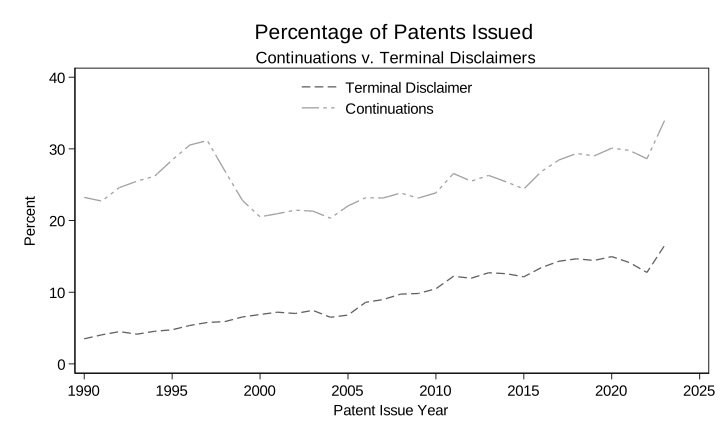
Thus, complaints about double patenting may just be masking complaints about the abuse of patent continuations to serially trivial patent improvements.[176] To test this, I plotted the data on terminal disclaimers over time as a proxy for double patents. As others have found,[177] they are growing in number, and now account for more than 15% of all issued patents. I also gathered and plotted data about all continuations and plotted their rate in comparison with terminal disclaimers.
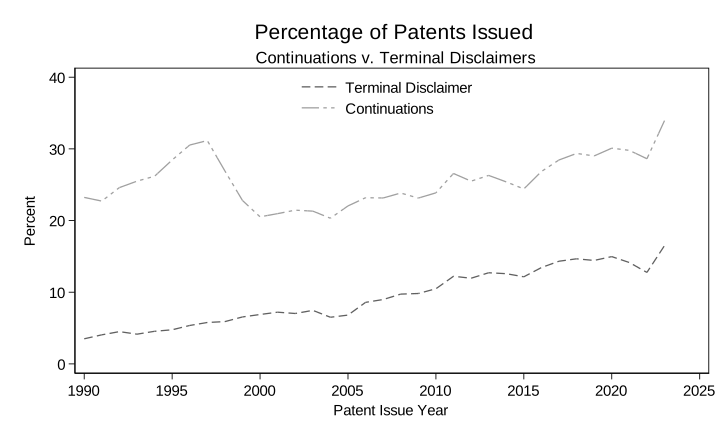
The graph appears to show that, other than a brief period around 1995,[178] terminal disclaimers appear to be growing (and shrinking) at approximately the same rate that continuation patents are growing. The statistics verified this. Stata’s dydx feature of the margins command reveals that the difference in slope between the two rates (that is the rate of change) differs by .002 (.2%) with a 95% confidence interval of .001 and .003.
In short, it appears that terminal disclaimers rise and fall with continuations. Perhaps there should be more terminal disclaimers, but double patenting appears to have been set in motion by co-pending applications allowed by the Supreme Court 150 years ago[179] and codified by Congress more than 70 years ago.[180]
Of course, a key question is whether changing the continuation rules or barring more double patents would change behavior. Patentees would be unlikely to disclose fewer “inventions” in their disclosures because they don’t know what they have invented—they only know what they think they invented.[181] One option is to better enforce written description rules to ensure that continuation patents are truly supported by the earlier filing before being granted; however, stricter enforcement might have little effect on inventor behavior.[182] Of course, the irony is that the closer the follow-on patent hews to the original specification—that is, the better the written description—the more likely the follow-on claims will be considered double patenting. The remaining policy choice would be to instead limit continuations. This might have two effects, both of which fall out of prospect theory’s prediction that patent value is maximized by unifying invention ownership.[183] First, patentees may well disclose less in each patent to save claims for later, independent patents. But this is risky, because without the benefit of co-pendency and priority, the prior patent filings may become actual prior art, rather than double patenting type prior art; no terminal disclaimer will save the later patent. Second, patentees may disclose more but find other ways to extend pendency if they are unable to file new patents. More amendments would likely come as well as more requests for continued examination, and issuance of the patent would likely be delayed, shortening its lifetime. This, in turn, might lead to patent term adjustment claims.
The ultimate policy prescription will depend in part on the approximately two-thirds of continuations that are not subject to a disclaimer. If those continuations claim a truly separate invention (such as the Microsoft example discussed above),[184] then limiting continuations will do little with respect to curbing double patenting. If, however, those continuations are mostly double patents that were somehow missed by the Patent Office, then limiting continuations seems more beneficial. And, of course, the tail wagging the dog are the relatively few Orange Book patents whose double patents are disclaimed but still exact a cost due to regulatory exclusivity.[185] Whether all continuation policy should be governed by around 3,000 problematic and regulated drug patents is an open question. Double patenting, terminal disclaimers, and these potential changes are examples of how legal structures affect patent prosecutor behavior.
C. Legislative History Rulemaking
Congress has narrowed the scope of prior art that can be applied to render a patent claim obvious. The 1952 Patent Act provided no provision for organizational inventive activity.[186] As a result, an invention by a coworker could be considered prior art to render another invention owned by the same company but by a different inventor obvious due to prior invention[187] or provided information (derivation).[188]
It took a while, but Congress eventually removed this type of information from the prior art for obviousness for coworkers in 1984.[189] This seems to imply that fewer patents will be subject to obviousness-type double patenting—if the prior invention is no longer considered prior art, then the new invention will not be obvious. But the legislative history specified that the Patent Office should continue to reject follow-on patents that do not sufficiently vary from earlier patents.[190]
In 2004, in a bill to further limit the effect of prior art—this time among joint ventures with different (non-coworker) owners—Senator Hatch recognized that the 1984 legislative history (rather than statute) mandated double patenting rejections for coworker double patents.[191] He went on to say (again in legislative history) that the new 2004 revision should also continue to bar double patents, but went even further, “mandating” in legislative history (but not the text of the bill) what the terminal disclaimer should include, specifically that two patents issued must be asserted at the same time even if owned by different parties.[192] The request was not unreasonable—because terminal disclaimers ordinarily render a patent unenforceable when it is assigned to another, a new procedure was necessary to address the situation where two different owners started with double patents and thus there was no assignment. What was unusual, however, was that a single senator, without a Congressional vote, might mandate whether and when patent owners assert their patents in response to a bar that is not in the statute in the first place, using a disclaimer whose animating statute only mentions patent terms and not ownership. Nonetheless, the Patent Office complied and has since required Senator Hatch’s requested terminal disclaimers.[193] Apparently, this is not the only time that agencies have promulgated rules based on legislative history.[194]
This new terminal disclaimer requirement means that any member of a joint venture obtaining a patent cannot later independently enforce a follow-on improvement. This could have the effect of disincentivizing such ventures in the first place.[195] Whether or not one agrees that this is good policy, it is questionable whether Patent Office rulemaking should be settling the question in response to floor reports.
The America Invents Act of 2011 continues the limitation on prior art used for obviousness from prior statutory amendments and made no further provision for double patenting.[196] One hearing witness commented that obviousness-type double patenting should continue.[197]
Of the more than 700,000 terminal disclaimers filed since 1990, nearly 70% were required by an examiner rejection for double patenting. So the PTO has been doing its part to ensure that double patenting is recognized and double patents are limited.
And disclaimers have apparently been required in patent families where each patent has different inventors, whether coworkers or joint venturers. So, the modifications to § 103 allowed more patents with mixed inventorship, and terminal disclaimers have ensured that those patents do not get separate ownership/enforcement. The following table shows how often patent families include inventors who differ from patent to patent.
The table shows, first, that the approximately 723,000 terminally disclaimed patents come from 143,750 patent families (that had more than one patent). The families had an average of 3.41 patents, with a maximum of more than 560. The median family had two patents and the seventy-fifth percentile had only three, which implies that a few large families skew the average.
About 80% of the families included patents that all had the same inventors, and this expanded to more than 97% for patents that had at least one inventor in common. But this means that 20% of the patents did not have all the same inventors, and 2% had none of the same inventors.[198] This implies that the various amendments to § 103 (and the AIA successor provisions) had the desired effect of encouraging patenting among different inventors and sometimes (though apparently rarely) even among different companies in joint development agreements. But it also shows that double patenting did not go away, and that terminal disclaimers did, in fact, continue to be necessary.
There are two takeaways from the history of amendments to § 103. First, as a statutory matter, double patenting with a terminal disclaimer appears to be safe as a historic common law, until it isn’t. The Supreme Court would likely uphold the long history of its application and Congress’s acquiescence to judicial and PTO procedure as constituting quasi-statutory stare decisis.[199] But cases like Star Athletica imply that this safety is not absolute.[200] There, the legislative history was as clear as it is with double patenting, if not clearer, and the Supreme Court disregarded it for the plain language of the statute.[201] There is no reason why that could not happen again. The Court might well invalidate any terminal disclaimer requirement beyond that allowed in the statute: disclaimer of term. Practically speaking, this would void common ownership requirements, as well as any other restrictions the PTO might require in terminal disclaimers in the future.
Second, the § 103 amendments imply that whatever sway the “prior patent as prior art” and “unclaimed but dedicated to the public” theories had in the past, they appear to have little influence on modern policy.[202] The legislative amendments that limit prior art but still use that art to bar double patents imply that patent term extension is the primary concern. But this creates the puzzle. As recently as a decade ago, Federal Circuit cases that “expanded” double patenting to include not just the claims but also the specification caused some uncertainty among applicants.[203] But to anyone familiar with the apparently forgotten history of double patenting, looking to the specification for unclaimed matter is critical to the analysis.[204] Because the rationale for double patenting is a moving target, so is the analysis.
The legislative history also illustrates that the word “type” in obviousness-type double patenting is doing a lot of work, because patents are treated as “patentably indistinct” from the prior patent so long as the claims are similar, without regard to what the specification teaches.[205] This creates the problem of the PTO’s proposed rule that follow-on patents should be invalid if the earlier patent is invalid. Congress has expressly mandated that certain prior art shall not render patents obvious.[206] Given this, invalidating a prior patent should not make any difference with respect to a later double patent without further analysis . . . at least as § 103 requires. But obviously,[207] invalidating the first patent does make a difference in how we view the second patentably indistinct patent.
Perhaps a better name would be “patentably indistinct double patenting.” The problem with this name is that it would cause confusion with the so-called “statutory” double patenting, which also applies to patentably indistinct claims.[208]
But this history raises another question. Why is it that the divisional statute, which states that upon division the prior application “shall not be used as a reference,”[209] creates a double patenting safe harbor, but the obviousness rule, which states that the prior patent “shall not preclude patentability,”[210] did not? The glib answer is that the obviousness rule was limited to “this section” (§ 103) but not to double patenting, but that does not answer why “used as a reference” in the divisional section should be given such a broad meaning that exceeds the normal use of “reference” to mean prior art under §§ 102 (anticipation) and 103 (obviousness).[211]
D. Post-URAA Double Patenting
If double patenting is all about term extension, then the Uruguay Round Agreements Act (URAA) should have obviated the need for double patenting rejections and terminal disclaimers. Beginning January 1, 1995, the URAA changed patent terms to expire twenty years from the earliest patent priority filing date rather than seventeen years from the patent grant date.[212] This change was expected to eliminate many of the concerns of continuation practice, primarily submarine patents that would be granted sometimes ten or twenty years after the original filing date but still carry seventeen-year terms.[213]
The URAA should have eliminated the need for terminal disclaimers in all continuation and divisional patents, because they would already expire at the same time. In other words, the URAA eliminated patent term extension in most cases we would expect. Indeed, this was the prediction at the time.[214]
But terminal disclaimer usage is on the rise![215] This seems wholly counterintuitive and leads to a puzzle. One theory is that patent term adjustments are the culprit—prosecution delays extend follow-on patents,[216] so terminal disclaimers are needed to shorten them.[217] I gathered data to see what types of patents are subject to terminal disclaimers.
The following chart shows different types of patents for which a terminal disclaimer was filed after May 29, 2000, the first time patent term adjustments were available—approximately 600,000 out of the 700,000 total disclaimers in the study. The table combines patent term adjustments (awarded for patent prosecution delay) and patent term extensions (awarded for regulatory delay). The chart not only divides by type of continuation, but it also shows whether a patent term extension/adjustment was granted.
The chart reveals some interesting patterns. First, only about 40% of the terminally disclaimed patents involved a patent term extension or adjustment. They may, of course, be the most impactful group. Also interesting is that non-co-pending patents with extensions garnered a much higher relative percentage of disclaimers than continuation patents. This could imply that non-co-pending patents are more likely to take longer to examine or be subject to regulatory delay because they are first in the chain. Even so, however, it does not appear that patent term extensions are driving the need for terminal disclaimers, even if those with extensions need disclaimers more. Instead, it appears that run-of-the-mill continuations drive most of the terminal disclaimer volume. Broadening reissues constitute very few of the double patenting disclaimers.
The substantial percentage of continuations-in-part is also a bit surprising, both how many there are, and how many lead to disclaimers—which one would not expect if there were new matter being added. However, the amount of new matter may vary. For example, Patent Nos. 11,023,702 and 11,610,429, each of which is a continuation-in-part,[218] only vary by a single figure and three paragraphs.
Whether the PTO is requiring terminal disclaimers or patentees are filing them unbidden is an answerable question using data from Patent Advisor, which tracks the basis for every office action rejection. The following table shows which types of continuations received PTO rejections due to obviousness-type double patenting.
As the table shows, nearly two-thirds of non-continuation patents that filed a terminal disclaimer did so in response to a rejection. About three-quarters of the continuation terminal disclaimers came from an office action, which implies the PTO is doing its job, even in those cases with extensions. Interestingly, much closer to half of the continuations-in-part received rejections. This may make sense given the new matter associated with a continuation-in-part.
The large number of rejections for divisionals deserves mention for two reasons. First, as discussed above, divisionals are supposed to be immune from double patenting rejections. However, because only those divisionals required by PTO restrictions are immune, the lopsided double patenting rejection rate for terminally disclaimed divisionals implies that a substantial number of divisionals are initiated by the patentee, but the patentee does not usually file a disclaimer unbidden as part of the new application. Second, even if not immune from double patenting bars, in theory, no divisional should need a disclaimer. By definition, a divisional is appropriate only when the specification describes two inventions. The Microsoft example above illustrates this—the divisional claimed an entirely different process and did not need a disclaimer.[219] But the data here implies that nearly 10% of all terminal disclaimers were on divisionals, which should have been separate inventions. The 42,692 disclaimers required by the PTO imply that applicants filed divisionals that should have been continuations because they were not patentably distinct. But the 25,749 disclaimers filed without a double patenting rejection is a head scratcher; it is almost an admission by the applicant that the divisional really shouldn’t have been a divisional. None of the divisional terminal disclaimers make much sense, but the one-third filed by applicants unbidden make the least sense. Nonetheless, there have been cases where a divisional was found to be patently indistinct,[220] so this phenomenon may not be as unusual as it theoretically seems. These examples may be the exceptions that justify the reason for the immunity rule: it is unfair for the PTO to require a divisional only for a court to later find it patentably indistinct.
Also telling is the outsized effect that co-pending applications (including continuations, continuations-in-part, and divisionals) have on the total count. These are the very patents that are supposed to expire at the same time as the original patent under the URAA. They are also the very patents that Congress explicitly allowed for in 1952.
The outsized rate of disclaimers for co-pending applications implies that continuations often differ very little from the original patent.[221] It also implies that even if the continuations are expiring at the same time (and they should be if there is no extension), double patenting rejections and terminal disclaimers are performing an important function unrelated to term extension, namely, ownership consolidation. Because disclaimers limit assignments (or enforcement by two different joint venturers), they ensure that serial patent filings do not lead to serial litigation by different plaintiffs, and only patentably distinct inventions are asserted by two different owners. This is not to say that several patents asserted serially by one company is a good thing; large patent portfolios might still be a concern even under common ownership.[222]
The data also imply that the problem of double patenting and terminal disclaimers may not be as bad as critics worry about when discussing how many disclaimers there are. The disclaimers are performing a service and, more important, disclaimers show that the double patenting problem is really a continuation problem rather than an extension of patent term problem.[223] Indeed, the real question might be: Why aren’t there more terminal disclaimers? How many are getting missed?
V. Conclusion
The law and policy of double patenting is a seat-of-the-pants endeavor, constantly adjusting to the most recent concerns of the patent ecosystem. Much of it makes little sense from a doctrinal perspective. Congress appears to have allowed multiple related patents in its continuation practice, but the courts and PTO have limited the scope—and ownership—of continuation patents. This might be a constitutional crisis if the legislative history did not contemplate this exact state of affairs. And so we have a statute that allows something that is also not allowed.
But much of it makes great sense from a doctrinal perspective. For more than a century, the courts have consistently held that multiple patents for indistinct inventions are disfavored. And Congress recognized this and provided terminal disclaimers as a potential option.
Because double patents were historically invalid, cases like Van Ornum imply that the PTO has free rein to determine what a terminal disclaimer might require (in addition to a limitation of term) to suit the policy needs of the day. Congress certainly thought so, as its bill authors instructed the PTO to expand its common ownership rules in legislative history. This will work as long as it works: When the PTO asks too much or the Supreme Court decides to limit rulemaking, the whole house of cards may fall.[224]
Some of the cracks began to show in a recent Federal Circuit case, In re Cellect.[225] The Federal Circuit considered an argument that because patent term extensions are statutory, they override terminal disclaimers and allow for adjustments that extend double patents.[226] The court easily dispatched with this argument, in part because Congress—this time—wrote language about terminal disclaimers into the statute.[227] But it need not have gone that way. And the court’s route to a ruling was circuitous, because it stated that a double patenting rejection was only available if the second patent had a longer term.[228] This framing opened the door for Cellect to argue that the term extension should not be considered when calculating the later patent’s longer term, an argument that the court rejected.[229]
But this “second patent is longer” framing is problematic in three respects. First, the myopic focus on term extension misses all the historic reasons for double patenting bars and cabins the PTO’s ability to make rejections, instead creating confusion about what a double patent is.[230] Second, it undermines the procedural rulemaking of terminal disclaimers. The justification for quasi-substantive rules is that the second patent is invalid, and so the applicant must agree to more than simply limited term to save the patent. But if the notion of double patenting only applies when one patent is longer, then much of that leverage is gone. This leads to third, simply relying on the URAA’s common patent term based on priority date will substantially decrease the opportunities for finding double patenting because the second patent will almost never have a later expiration date; this can increase the other harms of double patenting that are unrelated to patent term extension, such as harassment by multiple (or even the same) patent owners or patent thickets. To its credit, in response to an argument based on the first (doctrinal confusion) problem, the Federal Circuit clarified its ruling some in a later case.[231]
In the end, the harms associated with double patenting are really a symptom of long-implemented policy that allows for continuation patents. As continuation practice goes, so goes double patenting. When viewed through the continuation lens, double patenting critics ought to encourage more double patenting rejections rather than less, because terminal disclaimers appear to be the best way to regulate continuation practice while avoiding scrutiny for rulemaking in conflict with the 1952 Patent Act.
Terminally disclaimed double patents may create search costs and drug patent thickets, but this would likely be true with any type of continuation patent; double patents are only a fraction of all continuations. If double patents were barred altogether, how much would it change the landscape? Probably more in pharmaceuticals than elsewhere. But we do not know, because none of these concerns are what has driven double patenting bars and terminal disclaimer rules for the last 140 years. This common law doctrine has not evolved to solve modern-day concerns because these were not the concerns it was designed to solve. The question is whether current patent policy—which is completely non-statutory—should be driven by a small group of highly impactful, but also highly regulated, drug patents, or whether there are better ways to approach solutions to high drug prices. This Article offers no answers but suggests that solutions may be more nuanced than anyone realizes.
In re Longi, 759 F.2d 887, 892 (Fed. Cir. 1985).
See, e.g., Mark A. Lemley & Lisa Larrimore Ouellette, Fixing Double Patenting, 74 Am. U. L. Rev. 1013, 1022 (2025); Sarfaraz K. Niazi, Contradicting Rulings of the US Patent Office on Double Patenting Jeopardize the Generic and Biosimilar Drugs, 13 Pharm. Pat. Analyst 95, 102 (2024) (“The US is the only country allowing double patenting that harms generic and biosimilar drugs due to the high litigation cost and delays that discourage smaller companies from entering the field.”); Douglas L. Rogers, Double Patenting: Follow-on Pharmaceutical Patents that Suppress Competition, 14 Nw. J. Tech. & Intell. Prop. 317, 377–78 (2017) (arguing for strengthening the double patenting prohibition).
Brad D. Pedersen, How to Resolve Double Patenting: Recognize It Is an Archaic Legal Doctrine That Was Effectively Eliminated for AIA Patents, 53 AIPLA Q.J. 33, 42, 55, 120 (2025). Kirk Hartung, History Has It: Time to Terminate Obviousness-Type Double Patenting, IPWatchdog (July 15, 2024, at 12:15 CT), https://ipwatchdog.com/2024/07/15/history-time-terminate-obviousness-type-double-patenting/id=178850/ [https://perma.cc/KJ85-VGZE]; Sherry Knowles & Anthony Prosser, Let’s Do Something About the Unauthorized Doctrine of Non-Statutory Judicially Created Obviousness-Type Double Patenting, IPWatchdog (Sep. 6, 2022, at 17:15 CT), https://ipwatchdog.com/2022/09/06/lets-something-unauthorized-doctrine-non-statutory-judicially-created-obviousness-type-double-patenting/id=151271/ [https://perma.cc/9QPQ-ZVGS].
Michael A. Carrier & S. Sean Tu, Why Pharmaceutical Patent Thickets Are Unique, 32 Tex. Intell. Prop. L.J. 79, 83, 98, 101, 110 (2024).
See S. Sean Tu, The Long CON: An Empirical Analysis of Pharmaceutical Patent Thickets, 86 U. Pitt. L. Rev. 213, 236–37 (2024). To be sure, double patenting can create thickets and increase search costs in non-pharmaceuticals, but the lack of regulatory exclusivity makes those costs more attenuated.
See infra Table 4.
35 U.S.C. § 154(a)(2).
See Terminal Disclaimer Practice to Obviate Nonstatutory Double Patenting; Withdrawal, 89 Fed. Reg. 96152 (Dec. 4, 2024); Terminal Disclaimer Practice to Obviate Nonstatutory Double Patenting, 89 Fed. Reg. 40439 (May 10, 2024).
See infra Section II.C.
See infra Section II.C.
Pederson, supra note 3, at 42, 120; Hartung, supra note 3; Knowles & Prosser, supra note 3.
See infra Section II.C.
In re Longi, 759 F.2d 887, 892 (Fed. Cir. 1985).
Odiorne v. Amesbury Nail Factory, 18 F. Cas. 578, 579 (1819) (No. 10,430).
See Joshua Glick, Comment, On the Road: The Supreme Court and the History of Circuit Riding, 24 Cardozo L. Rev. 1753, 1757, 1797 (2003) (discussing the practice of riding circuit).
Odiorne, 18 F. Cas. at 579. A patentee’s earlier patent would not be “invention” type prior art (35 U.S.C. §§ 102(a), 102(e)) for the same invention and the law was unsettled whether statutory bar art (35 U.S.C. § 102(b)) would apply for obviousness until 1965. In re Foster, 343 F.2d 980, 988–89 (C.C.P.A. 1965).
Odiorne, 18 F. Cas. at 579; U.S. Const. art. I, § 8, cl. 8.
This will make ten.
These counts are based on a Westlaw search on September 6, 2025, of all citing references for the case “Odiorne v. Amesbury Nail Factory, 18 F. Cas. 578 (1819) (No. 10,430).” This yielded eight total cases, of which five are district court cases, and nine articles.
Lowell v. Lewis, 15 F. Cas. 1018, 1019 (1817) (No. 8,568).
These counts are based on a Westlaw search on September 6, 2025, of citing references to “Lowell v. Lewis, 15 F. Cas. 1018, 1019 (1817) (No. 8,568).” This yielded eight Supreme Court cases and 322 articles.
Michael Risch, Reinventing Usefulness, 2010 BYU L. Rev. 1195, 1205; Andrew Gilden & Sarah R. Wasserman Rajec, Patenting the Taboo: Sex, Drugs, and Abortion, Yale J.L. & Tech. (forthcoming 2025) (manuscript at 6–7), https://papers.ssrn.com/abstract=5035245 [https://perma.cc/2PVD-37T6].
Though my takeaways are different, others have analyzed the cases in some detail as well. See, e.g., Mark R. Carter, Plugging the Two-Claim Double-Patenting Loophole, 101 J. Pat. & Trademark Off. Soc’y 400, 410–414 (2021).
Suffolk Co. v. Hayden, 70 U.S. (3 Wall.) 315, 316, 319 (1865).
Id. at 319 (“And it is insisted that, for this reason, this prior patent for the same improvement is void. This is, obviously, a misapprehension. The last, not the first, is void.”).
See id.; cf. Act of July 4, 1836, ch. 357, 5 Stat. 117, § 13 (“[W]henever the original patentee shall be desirous of adding the description and specification of any new improvement of the original invention or discovery which shall have been invented or discovered by him subsequent to the date of his patent, he may, like proceedings being had in all respects as in the case of original applications . . . have the same annexed to the original description and specification . . . .”).
Suffolk, 70 U.S. (3 Wall.) at 318 (“But the answer to this ground of defence is, that it appeared that Hayden, the patentee had pending before the commissioner of patents an application for this same improvement at the time he described it in the specification of the [patent in suit], which was, doubtless, the reason for not claiming it in this patent. The description in no sense affected this application thus pending before the commissioner; and, while it remained before him, repelled any inference of abandonment or dedication from the omission to again claim it.”).
See id. at 319 (“We do not perceive any objection to this proceeding. It simplified the application, and disembarrassed it from its connection with other improvements claimed; and, doubtless, hastened the granting of the patent.”); Roy F. Lovell, Double Patenting with Relation to Co-Pending Applications, 9 J. Pat. Off. Soc’y 111, 125 (1926) (noting that Suffolk was a continuation).
35 U.S.C. § 120.
Id. § 121.
Godfrey v. Eames, 68 U.S. (1 Wall.) 317, 325 (1864) was the first.
Lovell, supra note 28, at 117–18 (“This presumption of dedication is repelled, however, if the inventions not claimed in the patent first to issue are claimed in applications contemporaneously pending in the Office.”); 35 U.S.C. § 121.
See Crown Cork & Seal Co. v. Ferdinand Gutmann Co., 304 U.S. 159, 165 (1938).
Id. at 165–68 (discussing Webster Elec. Co. v. Splitdorf Elec. Co., 264 U.S. 463 (1924)).
James v. Campbell, 104 U.S. 356, 382–83 (1881).
O’Reilly v. Morse, 56 U.S. 62, 122 (1853); Adam Mossoff, O’Reilly v. Morse and Claiming a “Principle” in Antebellum Era Patent Law, 71 Case W. Rsrv. L. Rev. 735, 740 nn.22–24 (2020) (discussing the disagreement in law as to whether Morse is an enablement or subject matter case); see also Chris H. Nanz, Double Patenting in Copending Applications, 1931 Chi.-Kent L. Rev. 165, 167 (arguing that O’Reilly was the first Supreme Court mention of double patenting).
William T. Bullinger, ‘Double Patenting’ and the 1952 Patent Act, 10 Pat. Trademark & Copy. J. Res. & Ed. 389, 396–97 (1967) (arguing that double patenting should be unnecessary for any prior art older than statutory bar). But see In re Braithwaite, 379 F.2d 594, 600 n.4 (C.C.P.A. 1967) (“While analogous to the non-obviousness requirement of 35 U.S.C. § 103, that section is not itself involved in double patenting rejections because the patent principally underlying the rejection is not prior art.”).
Mosler Safe & Lock Co. v. Mosler, 127 U.S. 354, 361–62 (1888) (first patent filed eleven months and granted one month before second patent was granted: “[T]he inventor cannot afterwards, on an independent application, secure a patent for the method or process of cutting away the metal and then bending it so as to produce the identical article covered by the previous patent, which article was described in that patent as produced by the method or process sought to be covered by taking out the second patent.”).
See McCreary v. Pa. Canal Co., 141 U.S. 459, 467 (1891).
Id.
Underwood v. Gerber, 149 U.S. 224, 229–31 (1893) (“As [the unasserted patent] does not claim the composition of matter, although it describes it, that composition must be regarded as disclaimed, and as being public property, and there was no invention in applying it to paper, as claimed in the patent sued on.”).
Miller v. Eagle Mfg. Co., 151 U.S. 186, 198 (1894); Westlaw, +“Double Patenting” (Sep. 21, 2025) (on file with the Houston Law Review) (filtered by “Cases”, “U.S. Supreme Court”) (sorted by “Most cited”).
Miller, 151 U.S. at 189.
Id. at 197–98.
Id. at 200 (“The patent of 1879 thus embraces both the lifting and the depressing effects or operations of the spring device, while that of 1881 seeks to cover only the increased lifting effect of the same device. The first patent clearly includes the second. No substantial distinction can be drawn between the two, which have the same element in combination, and the same spring arrangement and adjustment to accomplish precisely the same lifting effect, increasing as the beams are raised from their operative positions. The matter sought to be covered by the second patent is inseparably involved in the matter embraced in the former patent, and this, under the authorities, renders the second patent void.”).
This sentence is based on a Westlaw search on October 24, 2025, of all citing references for the case “Odiorne v. Amesbury Nail Factory, 18 F. Cas. 578 (1819) (No. 10,430).” This yielded eight total cases, seven of which are not Supreme Court cases.
Emerson Stringham, Double Patenting 19 (1933).
Elec. Storage Battery Co. v. Shimadzu, 307 U.S. 5, 21–22 (1939) (quoting the district court but remanding on other grounds: “There is no double patenting involved. The two patents issued on the same day. They both expired on the same day. There can be no extension of the monopoly and one is not prior art against the other.”).
Stringham, supra note 47, at 27 (“The question therefore is not one of reliance upon the prior art of the reissue patent as against a co-pending patent, or of double patenting, or of the overlapping of specific and generic patents. It is the attempted extension of the monopoly of the expired reissue patent in Inwood and Lavenberg’s invention by resort to the machine patent . . . .” (quoting Saranac Mach. Co. v. Wirebounds Co., 282 U.S. 704, 715 (1931))).
Id. at 368 (“Extension of monopoly has generally been recognized as the main reason for holding a second patent bad on the ground of double patenting.”).
Gilead Scis., Inc. v. Natco Pharma Ltd., 753 F.3d 1208, 1217 (Fed. Cir. 2014).
Lovell, supra note 28, at 116 (discussing Ex parte Holt, which invalidated earlier filed patent due to double patenting of later filed patent that issued first).
George M. Doherty, Double Patenting and Section 121-Multiply or Divide?, 54 J. Pat. Off. Soc’y 583, 588–89 (1972).
Pun intended. The earliest appearance of “obviousness-type double patenting” in Lexis is 1966. In re Bowers, 359 F.2d 886, 891–92, 891 n.7 (C.C.P.A. 1966) (“While in those cases we held that an ‘obvious’ type double patenting rejection could be overcome by filing a terminal disclaimer . . . .”). But see In re Allen, 343 F.2d 482, 489 (C.C.P.A. 1965) (“[I]t should be noted that although this court in Christiansen used an analysis similar to that used in an obviousness case, an obviousness type of analysis was not applied in Sarrett.”).
U.S. Court of Customs Appeals, Fed. Jud. Ctr., https://www.fjc.gov/history/timeline/us-court-customs-appeals [https://perma.cc/2DEQ-V639] (last visited Sep. 15, 2025) (“The U.S. Court of Appeals for the Federal Circuit, upon its creation in 1982, absorbed the U.S. Court of Customs and Patent Appeals.”).
See In re Coleman, 189 F.2d 976, 979 (C.C.P.A. 1951) (considering inventive concepts but not performing obviousness style analysis); U.S. Court of Customs Appeals, Fed. Jud. Ctr., https://www.fjc.gov/history/timeline/us-court-customs-appeals [(((insert permalink)))] (last visited Sep. 15, 2025).In re Coleman, 189 F.2d 976, 979 (C.C.P.A. 1951) (considering inventive concepts but not performing obviousness style analysis).
Id. at 978; In re Mason, 62 F.2d 185, 187 (C.C.P.A. 1932); In re Thompson, 62 F.2d 90, 92 (C.C.P.A. 1932).
In re Mason, 62 F.2d at 187 (“The real test in such cases is whether the application presents claims that are inventive over the claims of the patent granted in a copending application. If not, then appellant had no legal right to an allowance of the application at the time the copending applications were allowed.”); In re Thompson, 62 F.2d at 91–92 (interpreting Miller v. Eagle: “That [Miller’s rule that continuations are double patenting] is sound and that it is generally followed by the courts is, we think, beyond dispute, provided always that the claims of the second patent or application show an inventive advance over the claims already granted in the first patent.”).
Montgomery Ward & Co. v. Gibbs, 27 F.2d 466, 469 (4th Cir. 1928) (co-pending patent was not double patenting where spring closure differed; slight difference was enough for divisional for different invention); Cookingham v. Warren Bros. Co., 3 F.2d 899, 902–03 (1925) (second patent on different pavement mixture was valid because inventions were independent with no discussion of obviousness); Sandy MacGregor Co. v. Vaco Grip Co., 2 F.2d 655, 658 (6th Cir. 1924) (“We therefore conclude that the presence of, for example, the inflated rubber tube as the extension member in the second numbered patent instead of the rubber cord of the first numbered, though it might not by itself be invention if some one else had earlier invented the first numbered [is not double patenting].”).
Hope Basket Co. v. Prod. Advancement Corp., 187 F.2d 1008, 1012–13 (6th Cir. 1951) (holding a basket made by a machine was not double patenting because basket could be made in other ways); Oliver United Filters v. Silver, 206 F.2d 658, 666 (10th Cir. 1953) (holding improvement in machine distinct from machine itself; no discussion of obviousness); Stringham, supra note 47, at 131 (discussing requirement of inventive distinction and genus/species in several opinions: “The foregoing decisions enunciate the broad rule that identic monopoly means inventively identical. But the standard of invention is sometimes lowered for this situation . . . .”).
In re Allen, 343 F.2d 482, 486 (C.C.P.A. 1965).
Id. at 487.
Id. at 487–88 (Almond, J., dissenting).
Id. at 489–90 (the dissent presents a fifth option that is based on a concurrence and also merges into the other categories).
See Douglas J. Kirk, Double Patenting and the Terminal Disclaimer, 55 J. Pat. Off. Soc’y 28, 42 (1973).
Citation analysis based on a Westlaw search on October 5, 2025, of all citing references for the case “In re Allen, 343 F.2d 482, 486 (C.C.P.A. 1965).” This yielded six total cases, five of which are not federal circuit court cases.
35 U.S.C. § 101.
In re Ockert, 245 F.2d 467, 469 (C.C.P.A. 1957).
See, e.g., KCJ Corp. v. Kinetic Concepts, Inc., 223 F.3d 1351, 1356 (Fed. Cir. 2000) (“Unless the claim is specific as to the number of elements, the article ‘a’ receives a singular interpretation only in rare circumstances when the patentee evinces a clear intent to so limit the article.”).
In re Isherwood, 46 App. D.C. 507, 512 (D.C. Cir. 1917).
In re Longi, 759 F.2d 887, 893 (Fed. Cir. 1985).
In re Isherwood, 46 App. D.C. at 510.
Odiorne v. Amesbury Nail Factory, 18 F. Cas. 578, 579 (1819) (No. 10,430); In re Isherwood, 46 App. D.C. at 510–11.
See, e.g., Miller v. Eagle Mfg. Co., 151 U.S. 186, 197–98 (1894) (“[T]he second patent, although containing a broader claim, more generical in its character than the specific claims contained in the prior patent, is also void; but that where the second patent covers matter described in the prior patent, essentially distinct and separable from the invention covered thereby and claims made thereunder, its validity may be sustained.”).
Hogg v. Emerson, 47 U.S. (6 How.) 437, 483–84 (1848) (allowing patent on three distinct inventions related to single subject matter: “There seems to have been no good reason at first, unless it be a fiscal one on the part of the government when issuing patents, why more than one in favor of the same inventor should not be embraced in one instrument . . . .”).
Abbvie Inc. v. Mathilda & Terence Kennedy Inst. of Rheumatology Tr., 764 F.3d 1366, 1372 (Fed. Cir. 2014) (“Thus, § 101 forbids an individual from obtaining more than one patent on the same invention, i.e., double patenting. As this court has explained, ‘a rejection based upon double patenting of the obviousness type’ is ‘grounded in public policy (a policy reflected in the patent statute)’ (quoting In re Longi, 759 F.2d at 892))”.
Id. But see In re Longi, 759 F.2d at 892 (describing same-invention double patenting as stemming from § 101, and obviousness-type as judge-made).
See Suffolk Co. v. Hayden, 70 U.S. (3 Wall.) 315, 319 (1865); supra note 27 and accompanying text.
See, e.g., Traitel Marble Co. v. U.T. Hungerford Brass & Copper Co., 22 F.2d 259, 262 (2d Cir. 1927).
Cf. Geneva Pharms., Inc. v. GlaxoSmithKline PLC, 349 F.3d 1373, 1379 (Fed. Cir. 2003) (warning that the issuance of a restriction requirement on patentably indistinct claims “would immunize the restricted application against nonstatutory double patenting rejections” and “prolong patent protection beyond the statutory term on obvious variants of the same invention”).
Perricone v. Medicis Pharm. Corp., 432 F.3d 1368, 1375 (Fed. Cir. 2005).
35 U.S.C. § 120.
35 U.S.C. § 253 (1952). This section has since been amended but retains its general character. See Leahy-Smith America Invents Act, Pub. L. No. 112-29, 125 Stat. 284, 334.
Patent Law Codification and Revision: Hearing on H.R. 3760 Before the Subcomm. No 3 of the H. Comm. on the Judiciary, 82nd Cong. 40, 46 (1951) (statement of Paul A. Rose, Chairman, Laws & Rules Comm., Am. Pat. L. Ass’n).
P.J. Federico, Commentary on the New Patent Act, 75 J. Pat. & Trademark Off. Soc’y 161, 210 (1993) (“No specific reason for this provision appears in the printed record, but its proponents contemplated that it might be effective in some instances, in combatting a defense of double patenting, to permit the patentee to cut back the term of a later issued patent so as to expire at the same time as the earlier issued patent and thus eliminate any charge of extension of monopoly.”).
Statutory Disclaimer in Patent, 17 Fed. Reg. 10864, 10869 (Dec. 2, 1952) (codified as amended at 37 C.F.R. § 1.321).
MPEP § 804.01 (2d ed., Nov. 1953).
See, e.g., In re Ockert, 245 F.2d 467, 467, 469 (C.C.P.A. 1957).
In re Zickendraht, 319 F.2d 225, 229 (C.C.P.A. 1963); id. at 232 (Rich, J., concurring).
In re Robeson, 331 F.2d 610, 613–14 (C.C.P.A. 1964) (“The second paragraph of 35 U.S.C. § 253, providing for a terminal disclaimer, was first enacted in 1952 and has no known antecedent in the earlier patent statutes. The legislative history and the Reviser’s Notes shed little light on exactly why Congress enacted that particular provision.” (footnote omitted)).
Id. at 614.
Id. (“Where the claims of a second application are substantially the same as those of the first patent, they are barred under 35 U.S.C. § 101.” (citing Miller v. Eagle Mfg. Co., 151 U.S. 186 (1894)).
Miller, 151 U.S. at 198.
In re Robeson, 331 F.2d at 615.
In re Siu, 222 F.2d 267, 269 (C.C.P.A. 1955).
Id. at 268, 270.
Id. at 270 (“The statement quoted above refutes the contention that it would be unobvious to one skilled in the art to try the Ladisch patent with glass as a starting material.”).
Id. at 269–70.
In re Robeson, 331 F.2d at 614–15.
Id. at 615 (footnote omitted).
In re Kaye, 332 F.2d 816, 817–19 (C.C.P.A. 1964).
Id. at 819–20.
In re Griswold, 365 F.2d 834, 840 (C.C.P.A. 1966) (analyzing two claims for identity rather than obviousness).
In re Robeson, 331 F.2d at 614; In re Braithwaite, 379 F.2d 594, 595, 600–01 (C.C.P.A. 1967).
In re Braithwaite, 379 F.2d at 601.
35 U.S.C. § 121 (“If two or more independent and distinct inventions are claimed in one application, the Director may require the application to be restricted to one of the inventions.”).
Id. (provided that the divisional application is filed before the patent application issues and otherwise complies § 120).
In re Ziegler, 443 F.2d 1211, 1215 (C.C.P.A. 1971); Boehringer Ingelheim Int’l GmbH v. Barr Labs., Inc., 592 F.3d 1340, 1352 (Fed. Cir. 2010).
35 U.S.C. § 121 (“A patent issuing on an application with respect to which a requirement for restriction under this section has been made, or on an application filed as a result of such a requirement, shall not be used as a reference either in the Patent and Trademark Office or in the courts against a divisional application or against the original application or any patent issued on either of them, if the divisional application is filed before the issuance of the patent on the other application.”).
E.g., Miller v. Eagle Mfg. Co., 151 U.S. 186, 189, 200 (1894) (applying patentable distinctiveness test to divisional); see also Doherty, supra note 53, at 597–98 (describing differences between 1952 Patent Act and prior case treatment of divisional patents; prior treatment disallowed divisionals for any claims arising from the same inventive acts).
E.g., In re Coleman, 189 F.2d 976, 981–82 (C.C.P.A. 1951) (“If division would have been necessarily required in the first instance, then double patenting cannot be urged if the copending claims issue in separate patents. If, conversely, a rejection on the ground of double patenting is proper it is a necessary corollary that a requirement of division would have been improper.”).
St. Jude Med., Inc. v. Access Closure, Inc., 729 F.3d 1369, 1376–77 (Fed. Cir. 2013) (“This conflicting result was recognized as inherently unfair, and the safe harbor was created to preclude it.”).
See Boehringer, 592 F.3d at 1352.
In re Robenson, 331 F.2d 610, 615 (C.C.P.A. 1964); see, e.g., Sandy MacGregor Co. v. Vaco Grip Co., 2 F.2d 655, 658 (6th Cir. 1924) (“When the claims are in separate patents, possible divergent ownership suggests complications, but we do not foresee any which compel hesitation in our conclusion.”). But see Stringham, supra note 47, at 71–72 (discussing concerns and unsettled case law of double litigation by different owners).
In re Griswold, 365 F.2d 834, 840 n.5 (C.C.P.A. 1966) (noting the first disclaimer in seen by the court: “The terminal disclaimers which have been filed are ingenious.”); In re Van Ornum, 686 F.2d 937, 948 (C.C.P.A. 1982) (noting informal use of common ownership rule in 1968 and official rule in 1971).
In re Jentoft, 392 F.2d 633, 640 (C.C.P.A. 1968) (“It will be observed that in Robeson we did not approve of [harassment by multiple owners] as grounds for supporting a rejection, we merely observed that they are points to be considered. We found them insufficient in Robeson to support the rejection.” (emphasis omitted)).
In re Van Ornum, 686 F.2d at 944–45.
Id. at 944 (citing Sandy MacGregor Co., 2 F.2d at 658) (disregarding claim that “divergent ownership” should lead to double patenting bar); see also Pedersen, supra note 3, at 66–67 (calling harassment by multiple owners a theoretical threat that has little evidentiary support). Of course, it may be that there is no harassment by multiple owners precisely because common ownership terminal disclaimers are doing their jobs, especially in the age of NPE purchasing and enforcement of patents. See generally Michael Risch, Licensing Acquired Patents, 21 Geo. Mason L. Rev. 979 (2014) (describing generally the economics of NPE patents).
37 C.F.R. § 1.321(c) (2024) (“A terminal disclaimer, when filed to obviate judicially created double patenting . . . must: . . . [i]nclude a provision that any patent . . . shall be enforceable only for and during such period that said patent is commonly owned with the application or patent which formed the basis for the judicially created double patenting.”).
Id. § 1.321(d).
Cf. Pope Mfg. Co. v. Gormully & Jeffery Mfg. Co., 144 U.S. 248, 252 (1892) (explaining that patentee cannot assign portion of a patent for enforcement). One might envision the second, double patent is merely an extension of the first.
37 C.F.R § 1.321(c).
See S. Sean Tu & Mark A. Lemley, What Litigators Can Teach the Patent Office about Pharmaceutical Patents, 99 Wash. U. L. Rev. 1673, 1704 & n.106 (2021) (finding that litigated patents had many more terminal disclaimers than control group).
See Perricone v. Medicis Pharm. Corp., 432 F.3d 1368, 1375 (Fed. Cir. 2005) (holding that a terminal disclaimer can save a patent even after a double patenting invalidity finding in court).
This example was picked essentially at random from the group of double patents identified in the empirical portion of this study.
U.S. Patent No. 7,644,239 (issued Jan. 5, 2010).
See 35 U.S.C. § 116 (defining joint inventors); MPEP § 602.09 (9th ed. Rev. 1, Nov. 2024) (defining filing requirements for joint inventors).
For those interested in real-world applications, presumably, this invention is similar to Intel Optane memory. Intel Optane Memory-Responsive Memory, Accelerated Performance, intel, https://www.intel.com/content/www/us/en/products/details/memory-storage/optane-memory.html [https://perma.cc/M7MJ-P4MH] (last visited Sep. 13, 2025).
U.S. Patent No. 9,405,693 col. 1 l. 60 (issued Aug. 2, 2016).
Id.
Id.; '239 Patent; U.S. Patent No. 8,041,904; U.S. Patent No. 8,255,645.
U.S. Patent No. 10,216,637 (issued Feb. 26, 2019).
’693 Patent col. 17 ll. 26–43.
’637 Patent col. 17 ll. 51–60.
Office Action (Aug. 28, 2017), U.S. Patent Application No. 15/216,059 (filed July 21, 2016).
Terminal Disclaimer (Dec. 6, 2017), U.S. Patent Application No. 15/216,059 (filed July 21, 2016).
See Olga Gurgula, Strategic Patenting by Pharmaceutical Companies–Should Competition Law Intervene?, 51 Int’l Rev. Intell. Prop. & Competition L. 1062, 1067 (2020).
Cesare Righi, Davide Cannito & Theodor Vladasel, Continuing Patent Applications at the USPTO, 52 Res. Pol’y, Feb. 8, 2023, at 3 (follow-on patents help inventors manage technological and commercial uncertainty and refine claims as research progresses; noting they can be “socially valuable if they stimulate innovation investments, early invention disclosure, and technology commercialization”).
Mark A. Lemley & Carl Shapiro, Probabilistic Patents, 19 J. Econ. Persps., Spring 2005, at 75, 81–82 (pharmaceutical and biotechnology companies often keep continuation applications pending for the entire lifetime of the original patent; those continuation practices harm other firms by increasing uncertainty and raising costs for new entrants); Tu & Lemley, supra note 123, at 1708 (“Because of the Hatch-Waxman regulatory framework, obtaining multiple patents can delay or prevent entry by a generic competitor regardless of whether those patents are valid.”).
United States Corporation Bureau, The Legal Profession, 31 Nat’l Corp. Rep. 37, 44 (1905); Recent Cases, 20 Harv. L. Rev. 65, 74 (1906); Notes of Recent Cases of Importance from the National Reporter System, 17 Green Bag 453, 460 (1905).
See Arthur W. Cowles, Can Division Practice Be Made Less Complicated and Expensive?, 1 J. Pat. Off. Soc’y 605, 607–08 (1919); C. H. Pierce, General Discussion of the Subject of Division—Rule 41, 1 J. Pat. Off. Soc’y 402, 412 (1919).
Nanz, supra note 36, at 166–67; Lovell, supra note 28, at 111.
See generally Stringham, supra note 47 (discussing the emerging doctrine in detail).
Donald G. Daus, Double Patenting: More Is Not Always Better, 73 J. Pat. & Trademark Off. Soc’y 740, 742 (1991) (“Miller appears to be the first U.S. Supreme Court decision in which the claims, rather than the specification, were used to determine that double patenting was present.”). See generally Dan L. Burk & Mark A. Lemley, Fence Posts or Sign Posts? Rethinking Patent Claim Construction, 157 U. Pa. L. Rev. 1743 (2009) (discussing historical shift from central to peripheral claiming).
Bullinger, supra note 37, at 395–96, 396 n.24; see Lemley & Ouellette, supra note 2, at 1023.
See, e.g., Charles L. Gholz, The Law of Double Patenting in the CCPA, 4 APLA Q.J. 262 (1976) (providing example of doctrinal analysis).
See, e.g., Mark A. Lemley & Kimberly A. Moore, Ending Abuse of Patent Continuations, 84 B.U. L. Rev. 63, 81–83 (2004); Rogers, supra note 2, at 378–79; Daniel Kazhdan, Obviousness-Type Double Patenting: Why It Exists and When It Applies, 53 Akron L. Rev. 1017, 1027 (2019); Lemley & Ouellette, supra note 2, at 1039.
Terminal Disclaimer Practice to Obviate Nonstatutory Double Patenting, 89 Fed. Reg. 40439 (May 10, 2024) (to be codified at 37 C.F.R. pt. 1).
Of course, if the follow-on claims are obvious, they could and should be invalidated in their own right just as if they were in the initial patent. But, other than non-co-pending claims that acted as true prior art, nothing in the history of double patenting suggests that the obvious claims in the second patent had some lesser claim to validity than obvious dependent claims appearing in the first patent. See, e.g., Federico, supra note 85, at 210.
See Lemley & Ouellette, supra note 2, at 1044 (“The USPTO’s proposed rule thus made good policy sense.”). The authors do propose a revision that makes the rule less draconian. Id.
See generally Terminal Disclaimer Practice to Obviate Nonstatutory Double Patenting: Document Comments, Regulations.gov (May 9, 2024), https://www.regulations.gov/document/PTO-P-2024-0003-0001/comment [https://perma.cc/RJK4-LPLZ] (showing 349 public comments expressing a variety of viewpoints).
Tafas v. Doll, 559 F.3d 1345, 1352, 1360 (Fed. Cir. 2009) (barring substantive rulemaking and procedural rulemaking that conflicts with the patent statute). But see In re Van Ornum, 686 F.2d 937, 945, 947–48 (C.C.P.A. 1982) (upholding common ownership requirements in terminal disclaimers as procedural rulemaking); see also Pederson, supra note 3, at 104 (arguing that proposed regulation was improper).
See Lemley & Ouellette, supra note 2, at 1040 (narrower follow-on patents would theoretically avoid prior art invalidating broader claims in first patent).
See, e.g., 150 Cong. Rec. S7520–21 (daily ed. June 25, 2004) (statement of Sen. Orrin Hatch).
See Bilski v. Kappos, 561 U.S. 593, 594 (2010) (“[T]he exceptions have defined the statute’s reach as a matter of statutory stare decisis going back 150 years.”). But cf. Michael Risch, Everything Is Patentable, 75 Tenn. L. Rev. 591, 592 (2008) (arguing that Supreme Court’s patentable subject matter rules are not that old).
See Helsinn Healthcare S.A. v. Teva Pharms. USA, Inc., 586 U.S. 123, 131 (2019) (“In light of this settled pre-AIA precedent on the meaning of ‘on sale,’ we presume that when Congress reenacted the same language in the AIA, it adopted the earlier judicial construction of that phrase.”).
Star Athletica, L.L.C. v. Varsity Brands, Inc., 580 U.S. 405, 421–22 (2017) (“[W]e necessarily abandon the distinction between ‘physical’ and ‘conceptual’ separability, which some courts and commentators have adopted based on the Copyright Act’s legislative history.”).
Virtually all of this data is publicly available, and I am happy to share Stata scripts to those who wish to recreate it.
I retrieved the data from https://www.uspto.gov/ip-policy/economic-research/research-datasets/patent-examination-research-dataset-public-pair [https://perma.cc/X2ZY-SBGY], but the USPTO is changing its data delivery portals, and the data will likely be available at https://data.uspto.gov/home [https://perma.cc/85FR-W4ST] in the future. Patent Examination Research Dataset (PatEx), USPTO, https://www.uspto.gov/ip-policy/economic-research/research-datasets/patent-examination-research-dataset-public-pair [https://perma.cc/48QG-JV29] (last visited Aug. 30, 2025).
Id.; Stuart J.H. Graham, Alan C. Marco & Richard Miller, The USPTO Patent Examination Research Dataset: A Window on Patent Processing, 27 J. Econ. & Mgmt. Strategy 554, 555, 559, 561 (2018).
Compare Annualized Data Downloads, PatentsView https://patentsview.org/data/annualized [https://perma.cc/M7J2-JTAE] (last visited Oct. 4, 2025) (showing data dictionary files and annualized datasets available through 2024), with Patent Examination Research Dataset (PatEx), supra note 159 (showing the most recent PatEx release as the 2022 update based on Public Pair records). The difference in terminal disclaimers is apparently about 10,000 over a 30+ year period. Lemley & Ouellette, supra note 2, at 1025 (showing about 735,000 terminal disclaimers of combined PatEx and PatentsView data compared to about 723,000 terminal disclaimers discussed in this Article).
Stuart Graham, Alan Marco & Richard Miller, The USPTO Patent Examination Research Dataset: A Window on the Process of Patent Examination 64, 80 (U.S. Pat. & Trademark Off., Working Paper No. 2015-4, 2015).
Bring Predictability and Productivity to Your Patent Prosecution Process, LexisNexis: Patent Advisor, https://www.lexisnexisip.com/solutions/patent-prosecution/patentadvisor/ [https://perma.cc/V2BR-EMQG] (last visited Aug. 25, 2025) (noting that this is a proprietary, non-publicly available data source).
Graham, Marco & Miller, supra note 162, at 95.
S. Sean Tu, Aaron S. Kesselheim & Bernard Chao, Extent of Drug Patents with Terminal Disclaimers and Obviousness-Type Double Patenting Rejections, 332 JAMA 837, 837 (2024); Carrier & Tu, supra note 4, at 106 & n.181 (presenting data showing that pharmaceutical patents are litigated at a substantially higher rate than high-technology patents).
35 U.S.C. § 120 (allowing for earlier priority date so long as continuation is filed before earlier patent issues). Cf. Federico, supra note 85, at 192 (discussing codification of informal continuation practice in place for approximately ninty years).
35 U.S.C. § 120 (“An application for patent for an invention disclosed in the manner provided by section 112(a) . . . in an application previously filed . . . .”); id. § 112(a) (requiring application to describe and enable one with skill in the art to make or use the invention).
At the time, patent expiration was based on patent issuance, not patent filing. See 35 U.S.C. § 154 (1952).
Eli Lilly & Co. v. Barr Labs., Inc., 251 F.3d 955, 971 (Fed. Cir. 2001) (string citing five cases, dating back to 1982: “Our case law firmly establishes that a later genus claim limitation is anticipated by, and therefore not patentably distinct from, an earlier species claim.”).
Cookingham v. Warren Bros. Co., 3 F.2d 899, 903 (9th Cir. 1925) (“Inventions that stand in relation by way of species and genus do not prevent an inventor from obtaining patent for each . . . .”).
In re Allen, 343 F.2d 482, 487 (C.C.P.A. 1965) (illustrating the debate through a comparison of the majority and dissent).
Using Continuation Applications Strategically, Cooley, https://www.cooley.com/protect-pages/2020/03/using-continuation-applications-strategically [https://perma.cc/XR8J-RU28] (last visited Aug. 31, 2025) (“For example, one strategy for a start-up could be to file an initial patent application with claims that cover the first iteration of the product and are of relatively modest scope. Because the claims are modest in scope, they may quickly result in a patent issuance . . . .”).
Carrier & Tu, supra note 4, at 87 (“As the generation number increases, the patent claims typically get narrower.”).
Federico, supra note 85, at 194.
Jo. Baily Brown, The Situation Confronting Our Patent System, 5 U. Pitt. L. Rev. 247, 267 (1939) (“Frequently the practical effect is to provide patents on what, from the public interest view point, is the same subject-matter, for a period much longer than seventeen years.”).
Lemley & Moore, supra note 147, at 81–82 (discussing role of continuations in double patenting and harm in pharmaceuticals beyond expiration date).
Lemley & Ouellette, supra note 2 at 1033, 1035–36.
As discussed in Section D, below, on January 1, 1995, the Uruguay Round Agreements Act changed patent terms from seventeen years after each continuation patent issued to twenty years after the earliest priority filing date for the continuation. The spike in continuation patents in the three years after the URAA went into effect likely represents a rush to get continuations filed before January 1, 1995. Enrique Seoane-Vazquez et al., Analysis of the Impact of the Uruguay Round Agreements Act on Pharmaceutical Patents, 64 Food & Drug L.J. 171, 174–75, 179 (2009) (“The use of continuing applications increased during the transitional period [before URAA fully took effect], and decreased in the post-URAA period.”).
Suffolk Co. v. Hayden, 70 U.S. (3 Wall.) 315, 318–19 (1865).
35 U.S.C. § 253 (1952).
Michael Risch, The Failure of Public Notice in Patent Prosecution, 21 Harv. J.L. & Tech. 179, 200 (2007) (“The true scope of the patentable invention, if anything in the application is patentable at all, is understandable only after the prior art search.”).
Id. at 227 (“Further, because the applicant is required to disclose the entire invention in the specification with the hope that no prior art will bar the claims, inventors will not experience any ex ante increase in the costs of innovation or in the selection of what discoveries to disclose.”).
Edmund W. Kitch, The Nature and Function of the Patent System, 20 J.L. & Econ. 265, 285–86 (1977).
See supra text accompanying notes 128–35.
Tu, Kesselheim & Chao, supra note 165, at 837 (finding 3,151 Orange Book patents with OTDP issues).
35 U.S.C. § 103 (1952).
See id. § 102(g).
See id. § 102(f).
Patent Law Amendments Act of 1984, Pub. L. No. 98-622, § 103, 98 Stat. 3383, 3384 (1984) (excluding sections 102(f) and 102(g) prior art from obviousness analysis if both inventions are owned by the same parent).
S. Rep. No. 98-663, at 8 (1984) (“[Double patenting rejections and terminal disclaimers] will be necessary in order to prevent an organization from obtaining two or more patents with different expiration dates covering nearly identical subject matter.”).
150 Cong. Rec. S7520 (daily ed. June 25, 2004) (statement of Sen. Orrin Hatch); see also Amy R. Motomura, Innovation and Own Prior Art, 72 Hastings L.J. 565, 585 (2021) (discussing 1984 amendment and follow-on guidelines).
150 Cong. Rec. S7521 (daily ed. June 25, 2004) (statement of Sen. Orrin Hatch) (“[I]n every situation where double patenting is created based upon revised section 103(c), the patentably indistinct patent must include a disclaimer that will require the owner of that patent to waive the right to enforce that patent separately from the first-issued patent.”).
37 C.F.R. § 1.321(d) (2024).
See, e.g., Laura E. Dolbow, Agency Adherence to Legislative History, 70 Admin. L. Rev. 569, 600 (2018) (studying FDA rulemaking based on legislative history).
David Silverstein, Obviousness-Type Double Patenting – A Surprising Impediment to Collaborative Research and Development, 46 Bus. L. Rev. 63, 66–67, 74 (2013).
N. Scott Pierce, Inventorship, Double Patenting, and the America Invents Act, 30 Berkeley Tech. L.J. 1613, 1673 (2015) (arguing that the AIA legislative history is silent on double patenting and the same rules should continue to apply). But see Pederson, supra note 3, at 53 (arguing that the AIA eliminated the double patenting bar). While Pederson makes several astute historical observations, this one is off base. Modern double patenting has almost entirely been based on non-prior art, and nothing in the AIA’s changing prior art to the first filing date affects that. Continuations having the same filing date are excluded from the prior art under both the AIA and prior law.
Committee Print Regarding Patent Quality Improvement Before the Subcomm. on Cts., Internet, and Intell. Prop. H. Comm. on the Judiciary, 109th Cong. 100 (2005) (statement of William L. LaFuze, Chair, Intell. Prop. L. Section of the A.B.A.).
These percentages are probably a little high, given potential errors in name matching.
Bilski v. Kappos, 561 U.S. 593, 602 (2010) (“And, in any case, these exceptions have defined the reach of the statute as a matter of statutory stare decisis going back 150 years.”).
Star Athletica, L.L.C. v. Varsity Brands, Inc., 580 U.S. 405, 421–22 (2017).
Id. at 416–17, 421–24. (“[W]e necessarily abandon the distinction between ‘physical’ and ‘conceptual’ separability, which some courts and commentators have adopted based on the Copyright Act’s legislative history.”).
Pierce, supra note 196, at 1673.
Christopher M. Holman, The Federal Circuit’s Ongoing Expansion of Obviousness-Type Double Patenting Creates Patent Prosecution Pitfalls, 33 Biotechnology L. Rep. 94, 95 (2014) (describing black letter law from leading patent treatise that only the claims are compared). But see Rogers, supra note 2, at 371 (arguing that the Federal Circuit was comparing claims only and not the specification).
See supra Part II for a history of double patenting and the importance of specification.
Kirk, supra note 65, at 31 (“However, it does not appear that this section is actually used to determine the differences in the claims in question in a double patenting rejection. . . . In the ‘obviousness’ type of double patenting rejection the test is not what would be obvions [sic] to one of ordinary skill in the art from reading the specification and claims; rather the inquiry is much more limited in nature and the patent is considered only to compare the invention defined in the patent claims with the invention defined in the application claims.”).
See supra Section IV.C.
Pun shamelessly intended again.
See supra Section II.B.
35 U.S.C. § 121 (2018).
35 U.S.C. § 103(c)(1) (2006) (pre-AIA) (“Subject matter developed by another person, which qualifies as prior art only under one or more of subsections (e), (f), and (g) of section 102 . . . , shall not preclude patentability under this section where the subject matter and the claimed invention were, at the time the claimed invention was made, owned by the same person or subject to an obligation of assignment to the same person.”).
See, e.g., 35 U.S.C. § 132(a) (2018) (“Whenever, on examination, any claim for a patent is rejected, or any objection or requirement made, the Director shall notify the applicant thereof, stating the reasons for such rejection, or objection or requirement, together with such information and references as may be useful in judging of the propriety of continuing the prosecution of his application . . . .” (emphasis added)).
35 U.S.C. § 154(a)(2) (2018); 35 U.S.C. § 154 (1988).
Lemley & Moore, supra note 147, at 79–80.
Patents Legislation: Hearings on H.R. 359, H.R. 632, H.R. 1732, and H.R. 1733 Before the Subcomm. on Cts & Intell. Prop., H. Comm. on the Judiciary, 104th Cong. 189 n.57 (1995) (report of Mark A. Lemley) (“Because under the new law any applications which claim the same United States priority date will automatically expire on the same day, the need for terminal disclaimers should decrease. They will be required only in an obviousness-type double patenting case arising from two separate filings of similar applications by the same patentee on different days, but within one year of each other. Any such situations are not captured by my study, but their effects should be statistically insignificant.”).
Lemley & Ouellette, supra note 2, at 1025–26, 1032–33.
Id. at 1036.
To be clear, Lemley & Ouellette do not argue that term adjustments cause more disclaimers, but their data shows that term disclaimers are prevalent in patents with extended terms. Id. at 1030, 1033.
Compare U.S. Patent No. 11,023,702, with U.S. Patent No. 11,610,429 (the '429 patent revised to include an additional figure and associated description broadening the functionality of the invention and describing an alternative embodiment when compared to the '702 patent). For completeness, the original patent was U.S. Patent No. 10,395,164.
See supra text accompanying notes 128–31.
St. Jude Med., Inc. v. Access Closure, Inc., 729 F.3d 1369, 1377, 1380 (Fed. Cir. 2013) (citing cases).
See generally Lemley & Moore, supra note 147 (discussing issue of continuations with lack of new value).
Michael Risch, Patent Portfolios as Securities, 63 Duke L.J. 89, 96–100, 103 (2013); Gideon Parchomovsky & R. Polk Wagner, Patent Portfolios, 154 U. Pa. L. Rev. 1, 65 (2005); Lemley & Ouellette, supra note 2, at 1029–30, 1038.
Alexander R. Trimble, A Continuation Application Is an Implicit Admission of Obviousness-Type Double Patenting When Filed from a Parent Patent, Mintz (Mar. 19, 2024), https://www.mintz.com/insights-center/viewpoints/2231/2024-03-19-continuation-application-implicit-admission-obviousness [https://perma.cc/99ZU-NNS7].
See, e.g., Pedersen, supra note 3, at 72 (arguing that Van Ornum is likely not good law after recent Federal Circuit and Supreme Court rulings on substantive rulemaking).
In re Cellect, LLC, 81 F.4th 1216, 1228–29 (Fed. Cir. 2023).
Id.
Id.
Id. at 1227–28.
Id. at 1226.
See, e.g., Stephen McBride, The Case for Using Filing Dates Instead of Expiration Dates to Determine Obviousness-Type Double Patenting (Part I), IPWatchdog (May 5, 2024, at 12:15 CT), https://ipwatchdog.com/2024/05/05/case-using-filing-dates-instead-expiration-dates-determine-obviousness-type-double-patenting-part/id=176127/ [https://perma.cc/XP4U-QTZV] (trying to make sense of the “second patent term is longer” rule).
Allergan USA, Inc. v. MSN Laboratories Priv. LTD., 111 F. 4th 1358, 1368–69 (Fed. Cir. 2024) (“The problem with that result, however, is that Cellect answered a different question than that at issue here.”).